
Running payroll in the United Arab Emirates looks easy from the outside. There's no personal income tax, so how hard can it be? Then you meet the Wage Protection System (WPS), gratuity rules, pension contributions for nationals, and strict 2026 salary payment deadlines, and the picture changes fast. One small payroll mistake can lead to compliance issues or even hiring restrictions. That's why payroll outsourcing in the UAE has become the preferred solution for businesses looking to simplify payroll and stay compliant. As demand grows, many employers also compare payroll outsourcing costs in the UAE to find a solution that fits their budget and operational needs.
The question is whether outsourcing is the right move for your business. Choosing one of the Best Payroll Outsourcing Companies in the UAE isn't a decision to rush, because you're entrusting a provider with one of your most critical business functions, employee salaries, and compliance. In this guide, we'll explain what payroll outsourcing is, why payroll management in the UAE is so challenging, what services providers offer, the regulations every employer must know, and how to choose the right payroll outsourcing partner for your business.
Key Takeaways
In this blog, we'll cover:
- What payroll outsourcing is and why UAE payroll is complex
- Why companies outsource and what services are included
- In-house vs outsourcing, plus the pros and cons
- Key UAE payroll regulations: WPS, gratuity, pensions, and more
- A payroll outsourcing checklist and how to choose a provider
- Payroll outsourcing costs in the UAE
What is Payroll Outsourcing?
It's a simple idea. Instead of doing payroll work in-house, you hand it to a specialist firm that does it for you. These payroll outsourcing companies that UAE employers hire are experts in the entire cycle, from calculating wages to filing payroll files and ensuring compliance. Many providers also integrate with your HRMS and support timesheet management, ensuring accurate attendance and working-hour data flows directly into payroll. You stay in charge of the decisions; they handle the heavy lifting. Think of a good payroll services partner in the UAE as an extension of your team, not a faceless vendor you email once a month. The best payroll service providers in the UAE combine local compliance expertise with technology that ensures transparency.
Why is it challenging to manage payroll in the UAE?
At a glance, the UAE payroll system seems straightforward, mostly because there's no personal income tax to deduct. Look closer, though, and it's anything but simple.
You've got the Wage Protection System watching every transfer, end-of-service benefits to calculate, and pension contributions for UAE and GCC nationals to manage. Rules also differ between the mainland and free zones, such as the DIFC and ADGM, which operate their own frameworks. On top of that, health insurance became mandatory for all private-sector staff nationwide in January 2025. So even a small error in your payroll management process in the UAE can snowball into fines or blocked work permits. This is exactly where strong UAE payroll compliance stops being a box-tick and becomes business-critical.
Why Companies Are Choosing Payroll Outsourcing in Dubai
Given all that complexity, it's no surprise that more firms are turning to payroll outsourcing Dubai specialists and providers across the wider region. In the capital, payroll outsourcing firms in Abu Dhabi serve larger corporates and government-linked entities, while payroll services providers in Dubai compete hard on technology and price. As businesses manage payroll, they must also account for factors such as the average salary in Dubai, which can influence payroll budgeting, compensation planning, and compliance. Here's what's driving the shift.
1. Ensuring Compliance with UAE Laws
Staying on the right side of the rules is the number-one worry for most employers. Providers of payroll outsourcing services in the UAE know the UAE labor law payroll requirements, the WPS rules, and gratuity regulations inside out, so your business stays compliant without you memorizing every clause. Reliable UAE payroll services keep you current as the rules change, and in 2026, they change often.
2. Saving Time and Operation Costs
Running payroll in-house costs real money once you add software, training, and staff. With payroll outsourcing companies, UAE businesses can tap into expertise to get accurate results at a lower total cost while improving expense management, and free their own people for work that actually grows the company. That efficiency is a big part of why outsourced payroll models in the UAE keep winning.
3. Access to Expert Knowledge
Partner with the right payroll company, UAE firm, and you plug straight into deep local expertise. A seasoned payroll provider in the UAE knows the quirks of mainland versus free-zone rules, which is invaluable for any business setting up or scaling here. That know-how is hard and expensive to build in-house.
4. Flexibility
Your payroll needs shift as you grow. The beauty of a good payroll solution UAE partner is that it scales with you, from five employees to fifty, without a hiring scramble. Whether you're expanding, restructuring, or hiring seasonally, payroll outsourcing UAE arrangements flex to fit.
What Services Are Included in Payroll Outsourcing in the UAE?
A full-service provider covers far more than pressing "pay." Typical payroll outsourcing services UAE firms deliver include:
- Salary calculations and salary processing in the UAE
- Preparation and submission of WPS files (WPS payroll UAE processing)
- Issuing compliant payslips and managing employee payroll UAE records
- Calculating end-of-service gratuity UAE liabilities
- Tracking leave and attendance
- Conducting payroll compliance audits
- Managing employee data securely
In short, quality payroll processing in the UAE bundles everything into one clean monthly cycle, so you sign off once, and the rest just happens. Many providers also include tools such as a leave encashment calculator to ensure accurate leave payouts alongside payroll. Good payroll administration in the UAE means fewer surprises and a proper audit trail.
In-House vs Payroll Outsourcing: A Detailed Comparison
Deciding between doing it yourself and outsourcing? Here's a clear side-by-side to help.
Factor | In-House Payroll | Payroll Outsourcing |
|---|---|---|
Control | Full control over processes | Shared control with visibility |
Compliance | Requires internal expertise | Managed by experts |
Cost | High setup and operational cost | Cost-effective, pay-as-you-go |
Accuracy | Depends on team expertise | High accuracy with automation |
Scalability | Limited, requires hiring | Easily scalable |
Technology | Requires investment in tools | Included in the service |
Risk | Higher risk of errors | Reduced compliance risk |
In-house gives you the most direct control. But an outsourced team is usually faster, more accurate, and less error-prone, simply because payroll is all they do. Many providers also offer tools such as an HR Audit Score Calculator to help businesses assess HR compliance alongside payroll operations. For most growing businesses, payroll outsourcing providers in the UAE offer a better balance of cost, accuracy, and peace of mind.
Key Payroll Regulations Every Business Must Know
Before you choose in-house or outsourced, get familiar with the core rules every UAE employer must follow. These sit at the heart of UAE payroll regulations.
Wage Protection System (WPS)
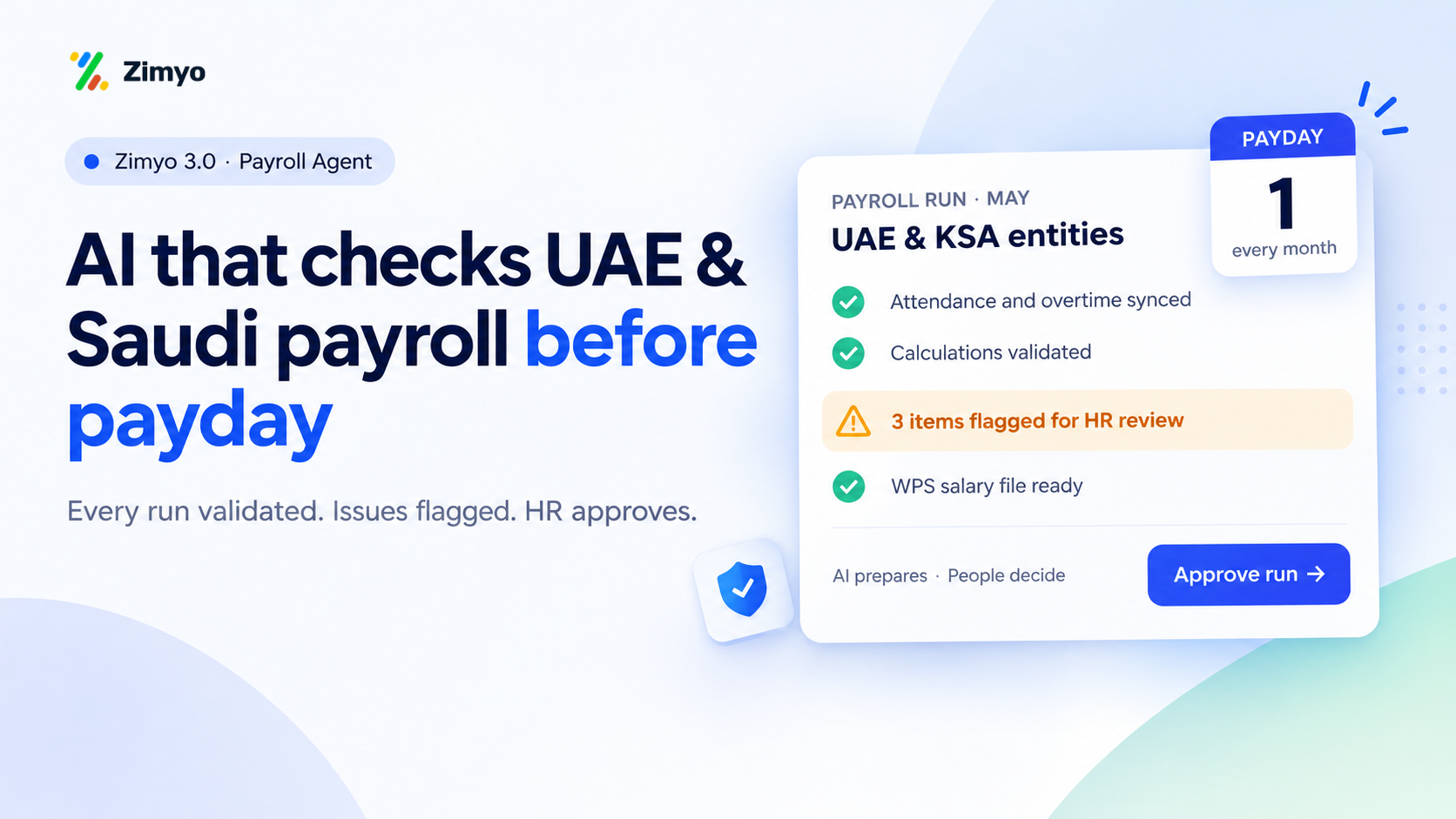
The Wage Protection System, which the that UAE authorities run, is mandatory and ensures employees are paid in full and on time through approved channels. Here's the crucial 2026 update: under the latest rules (Ministerial Resolution No. 340 of 2026), the old 15-day grace period has been scrapped, and salaries must now be paid by the first day of each month. Warnings start almost immediately, and continued delays can result in suspension of your work permits within about 17 days. Solid WPS compliance in the UAE is no longer optional, and this is one area where a provider handling your WPS payroll and UAE filings truly earns its fee.
End of Service Benefits (EOSB)
Employees who complete at least a year are entitled to a gratuity based on their basic salary and length of service (21 days' pay per year for the first five years, then 30 days' pay thereafter, capped at two years' salary). In the DIFC free zone, the traditional gratuity has been replaced by a funded savings scheme known as DEWS, so free-zone rules can differ from the mainland.
Pension Contributions
For UAE and GCC nationals, employers must contribute to pension and social-security schemes through the GPSSA. Expat employees don't have these deductions; instead, their entitlement is the end-of-service gratuity. As organizations adopt flexible work models, HR software helps businesses manage remote work while ensuring payroll, attendance, and compliance processes remain accurate. And to clear up a common mix-up: there is no payroll tax UAE employers withhold from salaries, only these national contributions and, separately, corporate tax on business profits.
Health Insurance Requirements
Health cover is tied to your residency visa, and since January 2025, employers must provide it to every private-sector employee, not just in Dubai and Abu Dhabi but across the whole country. It's a core part of onboarding any new hire.
Data Protection Laws
Payroll means handling sensitive personal data, so companies must comply with the UAE's Personal Data Protection Law. Any provider you use for payroll outsourcing in Dubai should have strong security and clear data-handling standards.
Common Myths About Payroll Outsourcing
It helps to clarify what payroll outsourcing companies that UAE businesses use actually do, because a couple of myths still put people off.
Myth 1: Only big companies need payroll outsourcing. The opposite is often true. Small and medium firms gain the most, staying lean and compliant without hiring a dedicated payroll team.
Myth 2: Outsourcing means losing control. Not really. Most providers give you full visibility via dashboards and reports, so you can see everything as they do the work.
Who Should Consider Payroll Outsourcing?
Payroll outsourcing in the UAE is especially valuable for:
- Growing SMEs and startups scaling quickly.
- International companies setting up in the UAE.
- Businesses struggling to keep up with the rules.
- Companies looking to simplify overtime calculations with an Overtime Pay Calculator.
If any of those sound like you, a payroll outsourcing provider is worth a serious look. Even smaller firms benefit, which is why payroll for small businesses in the UAE has become one of the fastest-growing corners of the market.
How To Pick the Right Company to Do Your Payroll
To find the right partner among the many payroll services in Dubai and nationwide options, weigh a few things:
- How much UAE-specific payroll experience do they have
- Whether they truly know WPS and the latest compliance rules
- Their data security features
- The quality of their reporting and dashboards
- Their pricing, ideally, is clear per-employee costs
Follow these steps, and you'll find the best payroll outsourcing company the UAE has for your size and sector. Some providers also offer HR and payroll software platforms in the UAE alongside the managed service, integrating employee engagement software to help businesses improve workforce satisfaction while providing a payroll management system dashboard for complete visibility. If you prefer a self-serve approach, standalone payroll software tools in the UAE are available, though you bear the compliance burden yourself.
Payroll Outsourcing Checklist
Ready to make the move? Use this quick checklist to keep the switch smooth and avoid the usual pitfalls. It walks you through what to sort out before, during, and after choosing a provider.
Before you outsource
- Map your current payroll process and list every pain point (deadlines missed, errors, time spent).
- Gather clean employee data: contracts, salaries, allowances, bank details, and Emirates IDs.
- Confirm your headcount, free-zone vs mainland split, and how many UAE or GCC nationals you employ.
- Set a realistic budget and compare it against your true in-house cost.
When vetting a provider
- Check their track record with UAE payroll compliance and references from businesses of your size.
- Confirm they handle WPS payroll UAE filings, gratuity, and payslips end-to-end.
- Review their data-security standards and where your data is stored (UAE PDPL matters here).
- Ask about their technology: employee self-service, reporting, and a clear payroll management system, and a UAE dashboard.
- Get transparent, per-employee pricing with no hidden setup or transaction fees.
During the transition
- Agree on a clear handover timeline and assign a named point of contact to ensure smooth coordination with your performance management system.
- Run a parallel payroll for the first cycle to catch any mismatches before go-live.
- Double-check the first Salary Information File against your employment contracts.
- Brief your team so everyone knows who owns what.
Ongoing
- Confirm salaries clear by the first-of-month WPS deadline every cycle.
- Review monthly reports and reconcile them against your records.
- Update the provider immediately when someone joins, leaves, or changes salary.
- Reassess the partnership as you scale to ensure the payroll solution in the UAE still fits.
Tick these off, and payroll outsourcing in the UAE becomes a genuinely low-stress part of running your business.
Payroll Outsourcing Cost in the UAE
One of the first questions every business asks is simple: What will this actually cost? The honest answer is that it depends, but there are clear patterns worth understanding before you request a quote.
Most providers charge on a per-employee, per-month basis, making pricing management an important factor when comparing payroll outsourcing services. As a rough, indicative guide, costs typically range between AED 15 and AED 75 per employee each month, with smaller headcounts usually paying toward the higher end of that range and larger workforces benefiting from volume discounts. Some providers also charge a one-time setup fee to onboard your data, while others bill separately for services such as WPS filing, end-of-service gratuity reporting, or additional compliance support. Understanding the provider's pricing management model and asking exactly what is included in the package can help you avoid unexpected costs and choose the most cost-effective solution.
Several factors move the price up or down:
- Company size and headcount. More employees usually means a lower per-head rate, but a higher total bill.
- Free zone vs mainland. Mainland payroll runs through MOHRE and WPS, while free zones like the DIFC or ADGM have their own frameworks, so mixed setups can add complexity and cost.
- Number of UAE and GCC nationals. Managing GPSSA pension contributions requires more work than with an all-expat team.
- Scope of service. Basic salary processing costs less than a full package with payslips, gratuity tracking, reporting, and compliance audits.
- Technology included. Providers offering an HR software and payroll software UAE dashboard may price slightly higher, but you get self-service and visibility in return.
Here's a simplified view of how pricing typically stacks up (figures are indicative and vary by provider and scope):
Small business (1–20 staff) | Flat fee or per-employee | Higher end, roughly AED 40–75 |
|---|---|---|
Growing SME (21–100 staff) | Per-employee, tiered | Mid-range, roughly AED 25–50 |
Larger company (100+ staff) | Volume-based per-employee | Lower end, roughly AED 15–30 |
For small business owners in the UAE, especially, the number that matters isn't just the monthly fee. Weigh it against the true cost of doing payroll in-house: software licenses, a dedicated salary, training, and the very real risk of fines from a single WPS slip. Seen that way, outsourced payroll UAE pricing often works out cheaper than it first appears. When comparing quotes, always compare what's included, not just the headline rate.
Pros and Cons of Payroll Outsourcing
Pros | Cons |
|---|---|
Reduces compliance risks | Depends on vendor timelines |
Saves time and operational effort | Ongoing service costs |
Provides access to expert knowledge | Less flexibility than in-house systems |
Improves payroll accuracy | Limited direct control over processes |
Ensures WPS and legal compliance | Customization may be restricted |
Scales easily with business growth | Data dependency on a third-party provider |
Conclusion
Managing payroll in the UAE isn't just about processing salaries; it's about ensuring accuracy, consistency, and compliance with ever-evolving labor laws and WPS regulations. While larger organizations with dedicated HRMS solutions may prefer to manage payroll in-house, doing so requires continuous investment in skilled teams, technology, and regulatory compliance. For many businesses, payroll outsourcing in the UAE offers a more efficient, cost-effective, and reliable way to streamline operations and reduce compliance risks. Choosing the right Payroll Management Software can further automate payroll processes, improve accuracy, and provide better visibility into employee payroll data.
Ultimately, the goal is simple, pay your employees accurately, on time, and in full compliance with UAE regulations. When payroll is managed efficiently, businesses can spend less time worrying about administrative tasks and more time focusing on growth and employee satisfaction. Whether you choose to outsource payroll or manage it internally, partnering with the right technology provider can make all the difference. Solutions like Zimyo combine modern HR, payroll, and compliance capabilities in a single platform, helping businesses simplify payroll management while staying compliant with UAE employment laws.