

When working professionals consider living and working in the United Arab Emirates, one thing that immediately comes to mind is its tax-friendly environment. The system of Taxation in the UAE, known for its simplicity, remains one of the most attractive in the world, and it benefits both employees and employers.
However, "no income tax" does not mean "no tax at all." While there is no personal income tax on salaries and wages, a number of indirect and corporate taxes apply, and the 2026 updates have made compliance stricter than ever. These taxes impact businesses, HR teams, and financial planning experts alike. Understanding how Taxation in the UAE works will help you stay compliant, optimize payroll processes, and make sharper financial decisions.
In this UAE Tax Guide, we focus on the UAE Tax System, key deductions and exemptions, and the crucial role that HR software in the UAE plays in facilitating compliance and payroll accuracy under the latest Tax Regulations.
Key Takeaways
Here is what this blog covers:
- How the UAE Tax System works and why "no income tax" doesn't mean "no tax at all."
- What employees should know about income tax and Payroll Tax in the UAE.
- UAE Corporate Tax in 2026: the 9% rate, thresholds, registration, and filing rules.
- How UAE VAT applies, including the 2026 e-invoicing rollout.
- Payroll and Social Security obligations that HR teams must manage.
- Deductions, exemptions, and Tax Exemption opportunities for businesses.
- Tax Residency, double taxation agreements, and support for expats.
- How HR software strengthens UAE Tax Compliance and UAE Business Compliance.
- Common compliance mistakes, 2026 penalties, and how to avoid them.
- The future of Taxation in the UAE and what it means for HR and finance leaders.
Understanding the System of Taxation in the UAE
The UAE Tax System is governed by the Federal Tax Authority (FTA), which is responsible for VAT, corporate tax, excise tax, and compliance matters across all Emirates. There is no income tax department as in other countries; instead, the FTA serves as the central authority ensuring that businesses meet their UAE Tax for Businesses obligations.
The Dubai tax system, like that of the other Emirates, follows a federal law, providing a unified framework nationwide. Key features include:
- No income tax on individual earnings.
- UAE Corporate Tax was introduced in 2023.
- Value Added Tax (VAT) at 5%.
- Excise tax on harmful goods.
For employers, this means payroll teams must understand how deductions, allowances, and taxable benefits interact with federal Tax Laws, even in a "no income tax" environment. Staying current with UAE Tax Regulations is now a continuous discipline rather than a once-a-year task.
Income Tax in UAE: What Employees Should Know
Probably the most well-known fact about working in the UAE is that there is no personal income tax on salaries. Whether local or expat, an individual's earnings are not subject to income tax, and there is no Payroll Tax on wages.
This means that:
- Employees receive their gross salary without any income tax deductions.
- There is no need for an income tax e-filing system or a calculator for individual employees.
- There is no income tax department collecting Payroll Tax from individuals.
Employers must nevertheless account for employee earnings, benefits, and dependents for social security and other statutory reporting obligations, especially for GCC nationals who contribute toward regional pension funds. Clean records here are the foundation of good UAE Payroll Compliance.
Corporate Tax: What Businesses Must File
Starting June 2023, the UAE introduced a 9% UAE Corporate Tax on business profits exceeding AED 375,000, while profits below this threshold are taxed at 0%. For UAE Corporate Tax 2026, the rate structure is unchanged, but compliance clarifications and enforcement have intensified. A 15% Domestic Minimum Top-up Tax also applies to very large multinational groups with consolidated global revenue of at least EUR 750 million, aligning the UAE with OECD global minimum tax rules.
This marks a major evolution in UAE Business Tax, bringing the country in line with global practices while remaining competitive. HR and finance departments must now ensure:
- Businesses in the UAE complete Corporate Tax Registration with the Federal Tax Authority, including free zone entities and companies with no revenue. New companies must register within three months of incorporation, and missing the deadline attracts a fixed AED 10,000 penalty.
- Annual UAE Corporate Tax Filing is completed accurately, generally within 9 months of the tax period ending. A company with a 31 December 2025 year-end, for example, must file its Tax Return and pay by 30 September 2026.
- Taxable income is correctly calculated after allowable adjustments and deductions.
The introduction of corporate tax has made HR and payroll data more crucial than ever. Payroll systems must integrate with accounting software to accurately calculate taxable income, expenses, and deductions, as reliable data underpins both Corporate Tax Registration and Corporate Tax Filing. These features are essential to maintain UAE Tax Compliance and reporting.
Value Added Tax (VAT): The Everyday Tax in the UAE
Introduced in 2018, UAE VAT applies a flat 5% tax on almost all goods and services. While VAT does not affect employee salaries, it directly shapes business expenses and associated claims.
Businesses with annual taxable turnover above AED 375,000 must register for Value Added Tax (VAT), submit returns, and maintain proper records. Voluntary registration is available from AED 187,500. Often, the HR team, working with finance, must ensure that travel claims and employee purchases meet VAT requirements.
A key 2026 development is the phased move to mandatory e-invoicing: a voluntary pilot for B2B and B2G transactions begins in July 2026, with mandatory adoption rolling out from 2027. Businesses also now have a five-year window to reclaim refundable VAT balances before the right expires. Because VAT is recoverable on certain expenses, tracking every invoice and receipt is a smart way to maintain transparency, avoid financial penalties, and keep your UAE Tax Compliance audit-ready.
Payroll and Social Security Tax
Although there is no federal income tax, the UAE operates a social security contribution system for UAE and GCC nationals. Contributions are split between employer and employee shares of the national salary, with the government adding a portion, and are deducted automatically from gross pay. (HR teams should confirm the current statutory rate applicable to their establishment, as pension rules were updated in recent years.)
For expatriates, no social security contribution applies, so gross salary effectively equals net salary. However, the distinction between local and foreign employees must be handled correctly in the HR system for payroll processing. Contributions may also differ for companies operating across multiple Emirates or free trade zones. A modern HR platform automates these payroll processes, monitors deductions, and generates reports that support both UAE Payroll Compliance and UAE Business Compliance in line with federal requirements.
Deductions, Exemptions, and Dependents
Even in an income-tax-free system, it is vital to understand the deductions and exemptions that apply to both employees and employers.
- Deductions: In the context of corporate Taxation in the UAE, allowable business expenses can be deducted from taxable profits to reduce overall liability. Accurate documentation is essential for sound Tax Planning.
- Exemptions: Businesses earning below AED 375,000 per year fall into the 0% band, and eligible small businesses can elect Small Business Relief for tax periods up to the end of 2026. Certain entities, such as those engaged in extractive natural-resource activities, may also qualify for a Tax Exemption under UAE law. Qualifying Free Zone Persons can access a 0% rate on qualifying income, which is another important Tax Exemption to plan around.
- Dependents: While individuals do not claim dependents for income tax purposes, employers often collect this information to manage benefits such as insurance and housing allowances that affect total compensation.
Through digitization, payroll and employee records can be managed so that deductions and exemptions are applied transparently and consistently.
Taxation for Expats and Double Taxation Agreements
For expatriates, the UAE is one of the most favorable destinations because it exempts personal income from tax. Even so, an expat must remain aware of their home country's tax rules, which is where Tax Residency becomes important.
The UAE has an extensive network of double taxation agreements (well over 100) that prevent an individual from being taxed twice on the same income. Expatriates can claim relief by obtaining a Tax Residency Certificate, issued by the FTA. An individual is generally a UAE tax resident by spending 183 days or more in the country over a rolling 12-month period, or 90 days or more while holding a UAE residence permit (or GCC/UAE nationality) plus a permanent home or employment in the UAE, or where their center of financial and personal interests is in the UAE.
HR and payroll teams typically compile the residency verification, salary certification, and financial information needed to support these Tax Residency applications.
Tax Compliance Management with HR Software
As the UAE moves further into line with international norms, Tax Compliance has become increasingly digital. Here is how HR software helps businesses stay ahead:
- Automated payroll calculations: ensure salaries, deductions, and employer contributions are computed accurately.
- Alignment with corporate and federal tax rules: systems connect with the FTA's EmaraTax e-filing environment to ease UAE VAT and corporate tax returns.
- Employee self-service portals: payslips, benefit summaries, and financial records are accessible without manual intervention, supporting transparency.
- Data for taxable income and audits: With accurate payroll records, HR teams can calculate taxable income confidently and respond to audits without hassle.
- Real-time regulatory updates: software updates keep organizations aligned with the latest Tax Laws and amendments to the UAE Tax System.
Together, these capabilities turn Business Compliance from a scramble into a routine, reducing the risk of costly errors.
Common Tax Compliance Mistakes and Penalties
While UAE Tax Regulations are straightforward, the consequences of non-compliance can be severe. The FTA is expanding its inspection and audit activity, particularly on VAT and corporate tax reporting.
Typical mistakes include:
- Late or improper filing of a Tax Return.
- Incomplete documentation of deductions.
- Failure to register within the allotted time.
Under the revised penalty regime that took effect in 2026, late payment now accrues interest at 14% per annum on unpaid tax, and serious or deliberate evasion can attract far heavier fines and, in extreme cases, criminal liability. These risks are considerably reduced with HR software and automation tools that safeguard UAE Tax Compliance.
From calculation to compliance, UAE Salary Calculator.
Managing Finances and Cross-Border Payments
Supporting cross-border financial planning is part of what HR professionals do for expatriate employees. Many expatriates rely on global payment platforms such as Wise to transfer money internationally.
Integrating payroll systems with such platforms allows employers to streamline salary transfers and lets employees receive funds in their preferred currencies, all while staying compliant with the UAE Tax System regulations.
Future of Taxation in the UAE
The UAE continues to evolve its tax framework to attract investors while maintaining transparency and global competitiveness. The coming years will bring further digital transformation, from the e-invoicing rollout to expanded EmaraTax capabilities and deeper clarifications on UAE Corporate Tax. Forward-looking Tax Planning now factors these changes in early.
For HR and finance leaders, this means embracing cloud-based HRMS platforms that guarantee full compliance with federal tax policies and future-proof payroll systems for whatever the next set of UAE Tax Regulations brings.
Conclusion
While the UAE's "no income tax" policy remains a cornerstone of its appeal, modern businesses cannot afford to overlook the wider taxation landscape. Taxation in the UAE now includes UAE Corporate Tax, UAE VAT, and payroll contributions that demand diligence, documentation, and digital preparedness. HR software plays a vital role in managing deductions, maintaining accurate employee data, calculating taxable income, and simplifying tax returns.
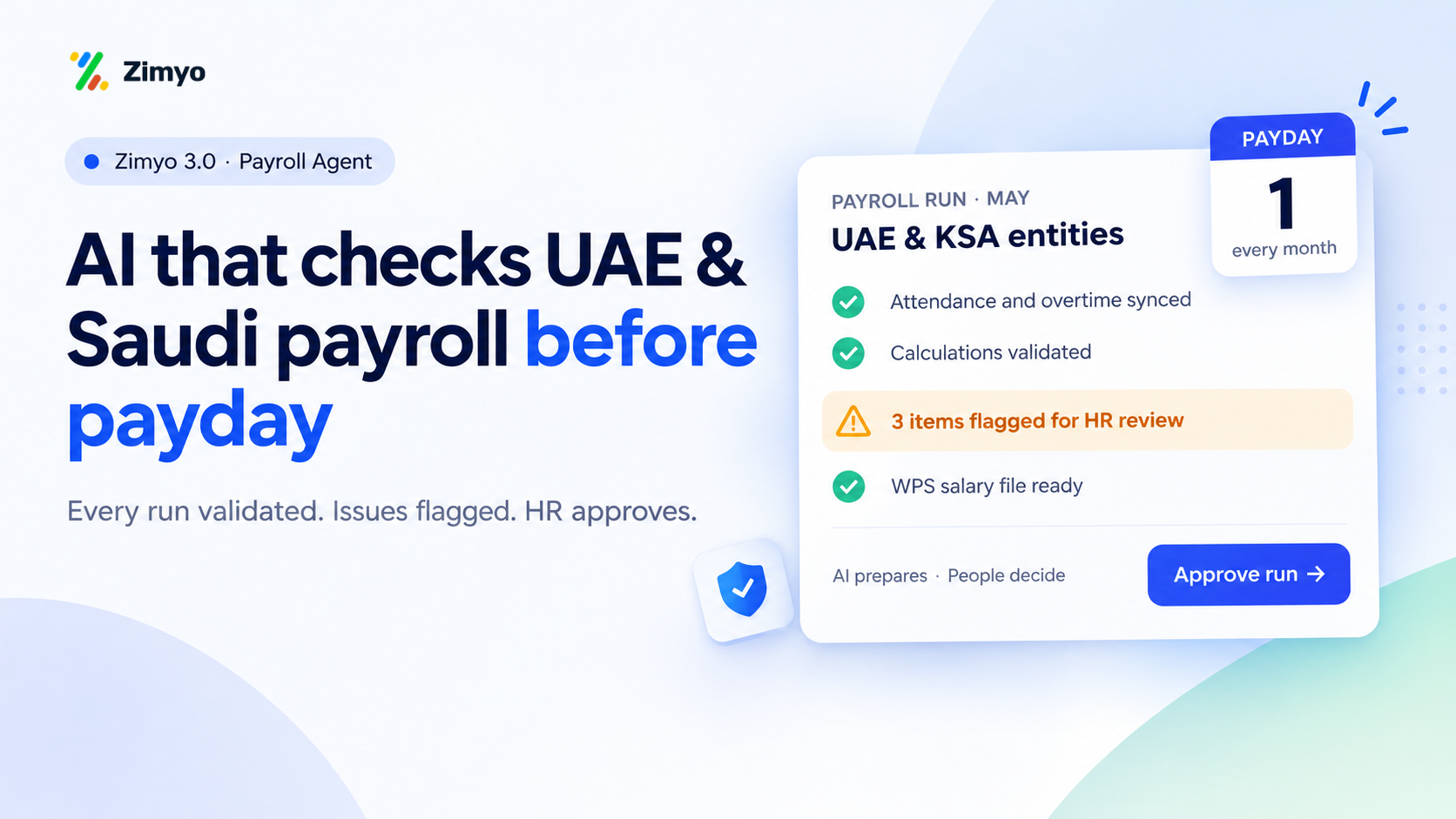
By automating and adopting compliance-first systems that align HR and finance functions, organizations can operate confidently within the UAE Tax System, maximize growth, and remain fully compliant. To make UAE Business Compliance effortless, Zimyo's HR and Payroll software platform runs accurate, WPS-aligned payroll, automates gratuity and end-of-service tracking, and keeps audit-ready records in order. Book your demo today for smarter, compliance-first HR management.