

Payroll calculations are no longer the issue in Saudi Arabia. It is about integration.
All salaries must match across four government systems: Qiwa for the contract, Mudad for the wage file, GOSI for social insurance, and Muqeem for residency. Any inconsistency between the two may lock out all visa-related services, lower the Nitaqat band, and incur fines, without the HR department knowing.
This is the actual criterion for choosing payroll software in Saudi Arabia in 2026, yet most comparisons of such solutions don't include it. Here is a comparison of eight payroll software options based on these criteria, along with their prices where available.
What Saudi Payroll Software Actually Has to Handle
The Compliance Chain
Saudi Arabia's regulatory platforms are interlinked, so payroll errors propagate rather than staying contained:
| System | Purpose | What payroll software must do |
|---|---|---|
| Qiwa | Employment contract authentication | Keep contract salary aligned with payroll before the run |
| Mudad | Wage Protection System filing | Post the wage file directly, without manual export |
| GOSI | Social insurance | Calculate and file contributions, split employer and employee shares |
| Muqeem | Iqama and visa management | Stay in sync so residency services aren't blocked |
Sequencing is important and gets people wrong; changes in salary need to happen prior to running the payroll cycle. Teams that update the payroll internally and reach Qiwa late enough actually create the kind of mismatch that the regulator tracks.
GOSI Now Runs Two Parallel Rate Schedules
This is the single most common source of miscalculation in Saudi payroll today, and any system you evaluate must handle both.
| Employee group | Employer | Employee | Combined |
|---|---|---|---|
| Saudi nationals registered before 3 July 2024 | 11.75% | 9.75% | 21.5% |
| Saudi nationals registered on or after 3 July 2024 | 12.75% | 10.75% | 23.5% (from 1 July 2026) |
| Non-Saudi employees | 2% (occupational hazards only) | 0% | 2% |
The new-system rate rises 0.5 percentage points each July through 2028 under the Social Insurance Law introduced by Royal Decree in July 2024. Contributions are calculated on basic salary plus housing allowance only, capped at SAR 45,000 per month.
If your software applies one rate table to everyone, it is wrong for part of your workforce every single month.
Best Payroll Software in Saudi Arabia: Comparison Table
| Platform | Best suited to | Published pricing | Rating (G2 / Capterra) | Government integration depth |
|---|---|---|---|---|
| Zimyo | 25–500 employees, Saudi + wider GCC | SAR 10 / 20 / 30 per user per month | 4.5 / 4.4 | Mudad, GOSI, Nitaqat, EOSB native |
| Jisr | 50–3,000 employees, KSA-only | No published rate card | Listed, no ratings / 4 | Mudad, GOSI, Muqeem, Saned native |
| PalmHR | Saudi SMEs wanting fast setup | No published rate card | Listed, no ratings / 4.2 | GOSI and Mudad native |
| ZenHR | Multi-country MENA operations | No published rate card | 4.6 / 4.7 | GOSI and Mudad native |
| Bayzat | GCC groups spanning UAE and KSA | No published rate card | 4.6 / 5 | Mudad, GOSI, Nitaqat, WPS |
| Mercans | 200+ employees, multinational | No published rate card | 4.8 / - | Full statutory, managed service |
| GulfHR | Middle East mid-market | No published rate card | 4 / 4.4 | Regional compliance, Arabic interface |
| Darwinbox | Large enterprise, multi-country | No published rate card | 4.3 / 4.2 | Verify Saudi depth before signing |
Top Payroll Software in Saudi Arabia: In Detail
1. Zimyo
Zimyo generates Mudad WPS files, calculates GOSI contributions for Saudi nationals across Annuities, Saned, and Occupational Hazards, computes Article 84 end-of-service, and tracks Nitaqat bands, with published pricing in Saudi riyals.
Zimyo runs payroll across seven Middle East markets from one system, so a Riyadh entity sits alongside Dubai or Doha operations on a single employee record rather than in parallel tools. Coverage spans core HR, payroll, performance, recruitment, engagement, timesheets, and learning.
For Saudi specifically: WPS SIF generation for Mudad in one click per payroll run, social insurance auto-calculation covering all three GOSI branches, EOSB handling that distinguishes resignation from termination and applies tenure tiers, and real-time Nitaqat dashboards with alerts before a band is breached. Contracts, payslips, and letters generate in Arabic and English side by side with full RTL support. Saudi public holidays, including National Day and Founding Day, are pre-loaded.
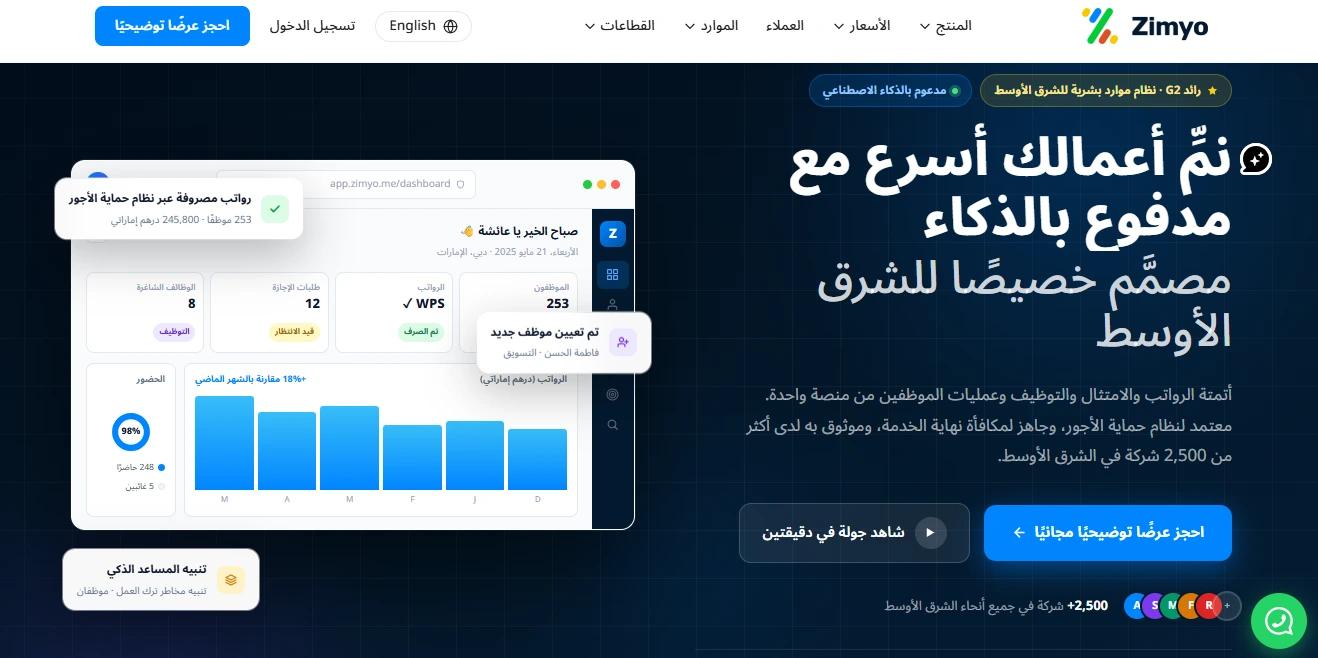
Pricing: Priced in riyals on the KSA Pricing Page – Basic: SAR 10 per month, Standard: SAR 20 per month, and Enterprise: SAR 30 per month per user with a 25-user minimum and billed monthly.
Rating: 4.5 on G2, 4.4 on Capterra.
Pros
- The only platform here with published Saudi pricing in SAR, so you can budget before a sales call
- Native Mudad, GOSI, Nitaqat, and EOSB rather than a localisation layer over a Western product
- One system across seven Middle East countries removes month-end reconciliation between tools
- Bilingual Arabic and English documents with full RTL
Cons
- A 25-user minimum rules out businesses below that headcount
- Built for multi-country Middle East operations, so a strictly KSA-only business is buying reach it won't use
Best for: 25–500 employees, particularly groups operating in Saudi alongside other GCC markets.
2. Jisr
Jisr is a Saudi-built platform positioned explicitly as a government compliance automation layer, with native integration into Mudad, GOSI, Saned, and Muqeem.
Jisr's argument is that other platforms are global products adapted for Saudi Arabia, while it was built for the Kingdom's portals from the start. Its integration history bears that out: GOSI and Saned in 2022, Muqeem in 2023, Mudad payroll processing in 2024, then violations, penalties, and end-of-service settlement calculations, followed by ZATCA-compliant invoices and sick leave. Payroll data entered once produces the full Mudad filing, including multi-bank submission.
The company reports 5,000+ businesses, 800,000+ employees, and more than SAR 10 billion processed, serving companies from 50 to 3,000 employees.
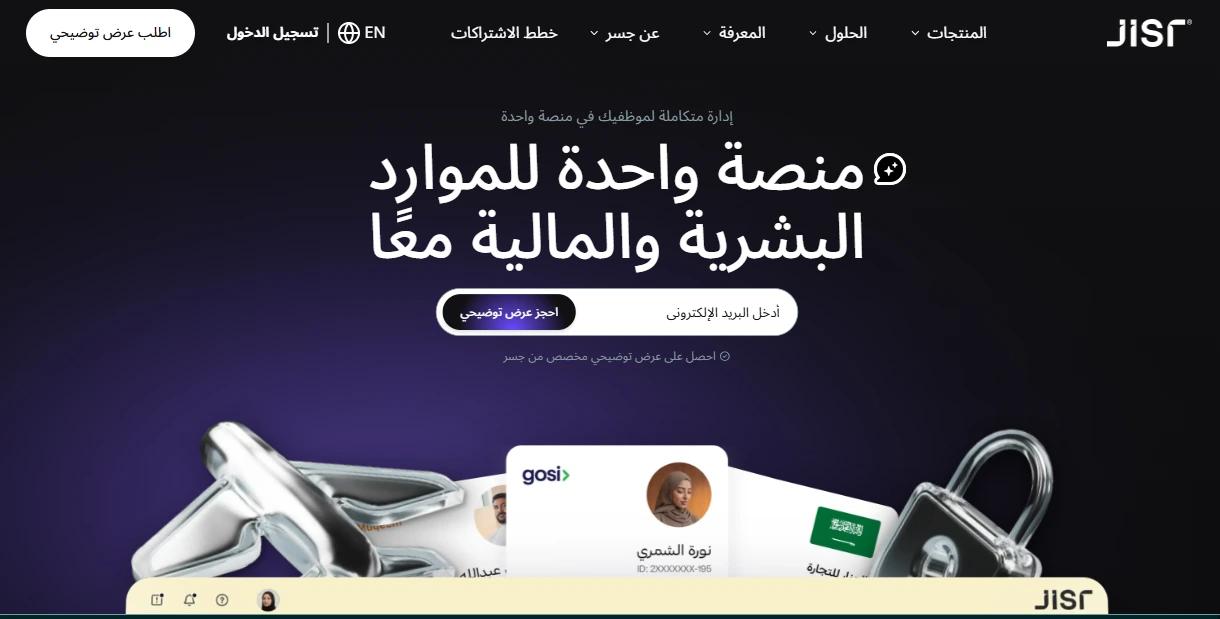
Pricing: No published rate card.
Rating: Not listed on G2, 4 on Capterra.
Pros
- The deepest Saudi government portal integration of any platform here
- Local hosting available, relevant where data residency is a procurement requirement
- Compliance violations flagged before submission rather than after
- Purpose-built rather than localised, so Saudi rules are the default, not a configuration
Cons
- Qiwa integration is listed on Jisr's own compliance page as coming soon rather than live, confirm status directly, since Qiwa contract authentication now affects Nitaqat counting
- KSA-focused, so expansion into the wider GCC likely means a second system
- No published pricing
- Entry point of around 50 employees puts it above the smallest SMEs
Best for: 50–3,000 employees operating solely in Saudi Arabia, where compliance automation is the deciding factor.
3. PalmHR
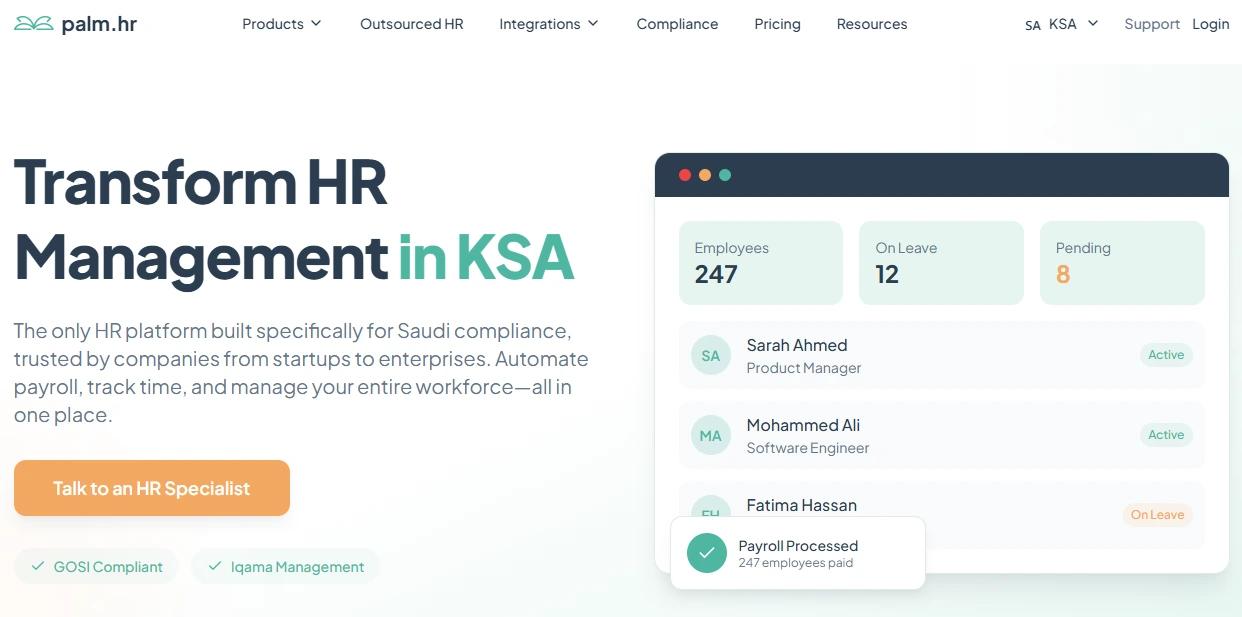
PalmHR is a Riyadh-born HRMS with native GOSI and Mudad integration, built for Saudi and GCC SMEs, with implementation for smaller companies typically completed within a week.
Founded in 2019 by Richard Schrems, Christoph Czichna, and Dragan Nikolic, PalmHR has raised $5 million across two rounds, including a pre-Series A in February 2023 led by Speedinvest and RAED Ventures, with Wamda Capital participating. It operates from Riyadh and Al Khobar.
The product covers people data, time and attendance, payroll with WPS compliance, and leave, with an outsourced HR service staffed by certified professionals available on top. Reviewers consistently single out ease of use and setup speed.
Pricing: No published rate card.
Rating: Holds G2 and (4.2)Capterra profiles, but review volume is low enough that no meaningful aggregate exists. Read individual reviews instead.
Pros
- Fast implementation, under seven days for smaller companies
- Native GOSI and Mudad, built in Saudi rather than adapted
- Optional outsourced HR service if you lack an internal function
- Strong usability reputation, with a G2 easiest-setup recognition
Cons
- Reviewers report gaps in benefits management and difficulty onboarding employees onto GOSI and health insurance platforms from within the product
- Mobile app criticized in public reviews
- Thin third-party review base compared with larger vendors
- Lighter on advanced performance and talent modules
Best for: Saudi SMEs that want to be live quickly and value simplicity over breadth.
4. ZenHR
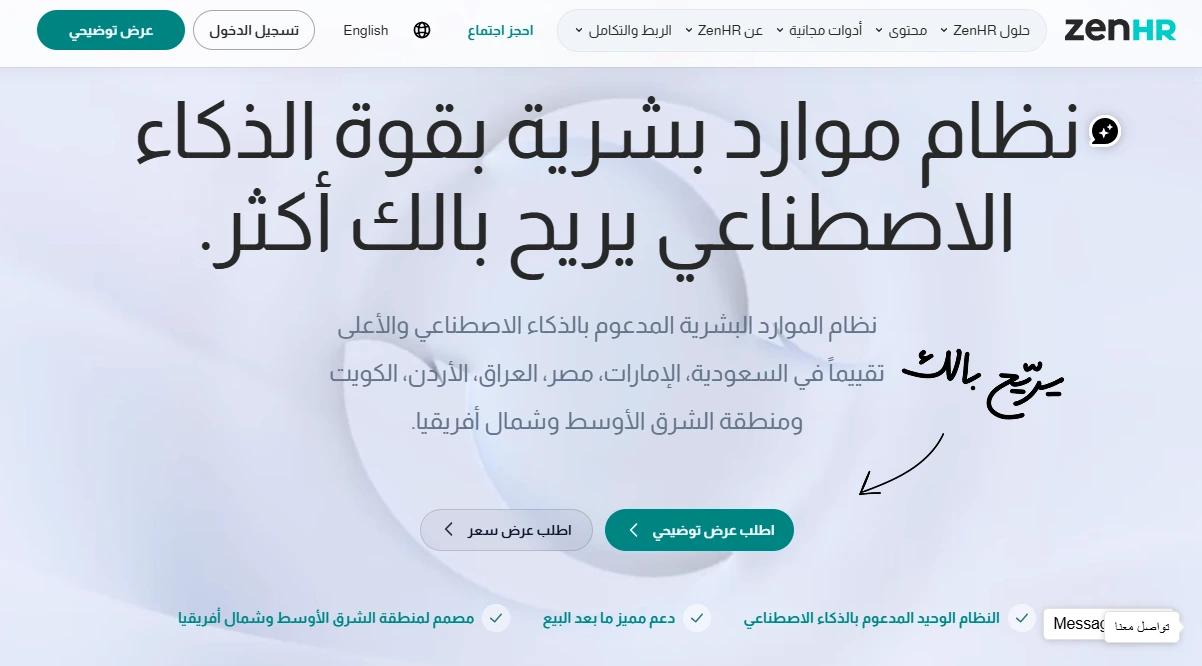
ZenHR is a MENA-native platform with native GOSI and Mudad posting, covering Saudi alongside multiple other regional markets from one system.
ZenHR handles Saudi payroll natively - GOSI file generation, Mudad wage posting, end-of-service by service years and contract type - while also supporting UAE, Jordan, Iraq, Kuwait, and Egypt with country-specific compliance logic. Attendance runs via GPS, QR, or biometric capture and feeds payroll directly. The platform holds SOC 2 Type II certification.
Pricing: No published rate card.
Rating: 4.6 on G2, 4.7 on Capterra.
Pros
- Native GOSI and Mudad posting without partner connectors
- Genuine multi-country MENA coverage if your footprint extends beyond the GCC
- SOC 2 Type II, relevant for regulated sectors
- The highest verified scores of any regional platform in this comparison
Cons
- Some reviewers report needing additional configuration for Saudi-specific requirements compared with KSA-native platforms
- Narrower functional footprint - lighter on learning management and advanced analytics
- No published pricing
- Payroll-led design means less depth in talent development
Best for: 20–500 employees running Saudi alongside Levant or North Africa operations.
5. Bayzat
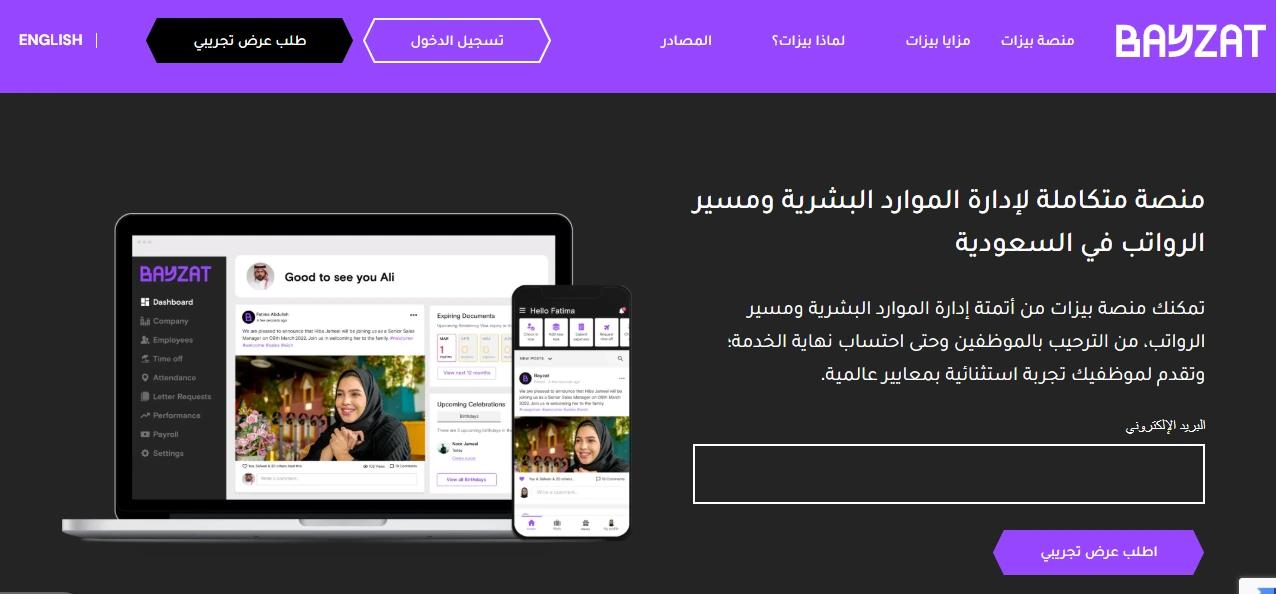
Bayzat is a GCC platform combining HR, payroll, and employee insurance, with Mudad, GOSI, Nitaqat, and WPS integration and enterprise security certifications.
One correction worth making, because several published comparisons get it wrong: Bayzat is a UAE company, not a Saudi one. It serves Saudi Arabia as part of a broader GCC footprint. That is not a weakness in itself, but it changes how you should assess its Saudi depth against a KSA-native platform.
Bayzat's differentiator is scope beyond payroll - employee medical insurance management, expenses, and cross-border payments sit inside the same product. The company reports 4,000+ companies and holds ISO 27001:2022 and SOC 2 Type 2 certification.
Pricing: No published rate card.
Rating: Holds a (4.6) G2 profile, (5) on Capterra, but review volume is low enough that no meaningful aggregate exists.
Pros
- Insurance management built in, which none of the pure payroll platforms offer
- ISO 27001:2022 and SOC 2 Type 2 security
- Genuine dual-market strength if you run UAE and Saudi entities together
- Finance features including expenses and cross-border payments
Cons
- UAE-origin, and at least one public reviewer describes it as less localized for Saudi than for UAE, test Saudi-specific workflows in a demo
- Broad scope means you may pay for insurance and finance modules you don't need
- No published pricing
- Nitaqat and Qiwa depth needs verifying against KSA-native competitors
Best for: GCC groups running UAE and Saudi entities where insurance administration matters.
6. Mercans
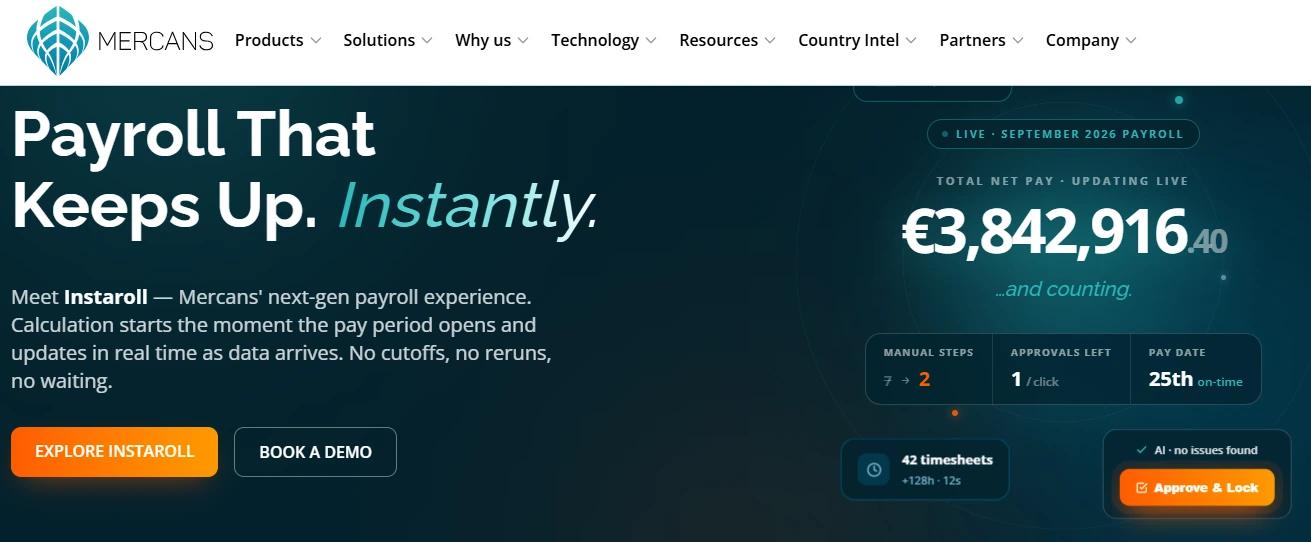
Mercans is a global payroll specialist offering managed Saudi payroll aligned to GOSI, Mudad, WPS and Qiwa, with Employer of Record services for companies without a local entity.
Mercans is a service-led option rather than self-serve software. It publishes detailed statutory guidance on Saudi payroll and operates across more than 160 countries with over 500 HR and payroll specialists. It has been recognized as a leader in payroll business process transformation by Avasant and in payroll services by ISG, and holds approved Binding Corporate Rules for data privacy.
Pricing: No published rate card. Enterprise pricing with implementation costs.
Rating: 4.8 on G2 - the highest here, from an enterprise-weighted sample. No Capterra profile found.
Pros
- Employer of Record option lets you hire in Saudi without establishing an entity
- Deep, actively maintained Saudi statutory expertise
- Saudi becomes one node in a unified global payroll rather than a separate system
- Approved Binding Corporate Rules, a meaningful data privacy credential
Cons
- Substantial overkill for a single Saudi entity under 200 people
- Service-led model rather than software you operate yourself
- Enterprise pricing and implementation timelines
- Less day-to-day HR functionality than the HRMS platforms here
Best for: 200+ employees, multinationals, and companies entering Saudi without a local entity.
7. GulfHR
GulfHR is a long-established Middle East HR and payroll system with an Arabic interface and more than two decades serving regional employers.
GulfHR has built its position on longevity and regional configurability rather than on the newest architecture. It handles payroll processing, payslip and report generation, salary advances, and regional compliance, with the ability to tailor payroll rules per organisation.
Pricing: No published rate card.
Rating: Listed on Capterra(4), (4.4) on Capterra - low review count.
Pros
- Over 20 years of Middle East operation and an established regional client base
- Arabic language interface
- Highly configurable payroll rules for organisations with unusual structures
- Broad Middle East coverage rather than single-country
Cons
- Public documentation on Saudi-specific Mudad, Qiwa and Nitaqat depth is limited; verify in a demo
- No published pricing or aggregate third-party rating
- Older platform architecture than the recently built KSA-native options
- Less visible product development cadence than the funded newer entrants
Best for: Middle East mid-market organisations that value regional longevity and configurability.
8. Darwinbox
Darwinbox is an enterprise HCM platform with significant Middle East presence, suited to large multi-country organisations that need analytics and workflow depth alongside payroll.
Darwinbox competes at the top of the market on breadth - talent, performance, analytics, and workflow automation well beyond payroll. For Saudi operations, the question is integration depth rather than feature count.
Pricing: No published rate card.
Rating: 4.3 on G2, 4.2 on Capterra.
Pros
- Enterprise-grade analytics, workflow automation and talent modules
- Strong multi-country capability for organisations well beyond the GCC
- Established Middle East footprint at enterprise scale
- Deep configurability for complex organisational structures
Cons
- At least one third-party comparison indicates Mudad posting may run through partner connectors rather than natively; confirm before signing
- Enterprise implementation timelines and cost
- Overkill for mid-market Saudi operations
- Saudi-specific compliance depth needs validating against KSA-native platforms
Best for: Large enterprises where Saudi is one part of a global HCM deployment.
Choosing By Situation
Under 25 employees. Check minimum seat counts before you shortlist - Zimyo starts at 25 users, and Jisr targets 50 and above. PalmHR is the most likely fit at this size, but confirm its minimum directly.
25–200 employees, Saudi only. Jisr and PalmHR are the KSA-native shortlist. Zimyo fits if you want published pricing and expect to add other GCC markets later.
25–500 employees, Saudi plus other GCC markets. Zimyo, Bayzat, and ZenHR all run multiple countries on one system. The deciding factor is usually whether you need insurance administration (Bayzat), broader MENA coverage (ZenHR), or cost transparency (Zimyo).
200+ employees or no local entity. Mercans for managed payroll and Employer of Record; Darwinbox if you need full enterprise HCM alongside it.
Three More Things Saudi-Specific Software Must Get Right
End-of-service benefits. Under Article 84 of the Saudi Labour Law, EOSB accrues at 15 days of wage per completed year for the first five years, then 30 days per year beyond five. Resignation between two and five years of service pays one-third of the full award. The calculation uses the last wage including fixed allowances, not basic salary alone.
Nitaqat. Saudization banding affects visa quotas and government service access. Systems that track it in real time let you see a band breach coming rather than discovering it when a work permit renewal fails.
No personal income tax. There is no income tax on employment income in Saudi Arabia. Any platform advertising income tax withholding or TDS calculation as a Saudi feature was built for another market.
Verify before configuring. GOSI rates vary each July based on the phased schedule, and information from various sources is inconsistent. Verify the updated rates from GOSI or your payroll consultant before implementation. Requirements by Mudad and Qiwa have been changing as well.
Software or Outsourced Provider?
Many businesses searching for payroll in Saudi Arabia are weighing two different things: buying software to run payroll in-house, or engaging a provider to run it for you.
Payroll software suits companies with an HR or finance function that can own the process. You control the data, costs scale per employee, and the system handles filings.
Managed payroll and outsourcing suit companies without a local entity, without an HR team, or with complex multi-country obligations. A provider takes on the processing and often the compliance liability. Mercans sits on that side.
The two are not mutually exclusive. Several platforms here offer software with an outsourced service layer on top; PalmHR and Bayzat both do.
Six Questions To Ask Every Vendor
- Do you post to Mudad natively, or through a partner connector? Native is when the wage file comes directly from the payroll system. A connector is when there is an export and upload of the file.
- How do you handle the two GOSI rate schedules? Ask them to show an employee registered before 3 July 2024 and one after, in the same payroll run.
- What is your Qiwa integration status today? It is not on the roadmap, but right now, contract authentication impacts Nitaqat numbers.
- Show me Article 84 end-of-service for a three-year resignation. The one-third rule for resignations between two and five years of service is where systems built elsewhere fail.
- Does your Nitaqat tracking alert before a band breach or report after? Only the first is useful.
- What does this cost per month in SAR for my headcount? Ask before the demo.
Conclusion
The feature list is unlikely to set these systems apart since they all have similar feature lists. It will be the degree of government integration that does.
Have each of the vendors demonstrate how they will perform live payroll processing for two employees, one Saudi employee registered before July 2024 and another one after, along with an expatriate, including producing a Mudad file, GOSI split, and Nitaqat effects. The systems designed for the Saudi market will demonstrate this in the demonstration.
Frequently Asked Questions
How much does payroll software cost in Saudi Arabia?
Zimyo publishes KSA pricing at SAR 10, 20, and 30 per user per month, minimum 25 users. Every other platform here quotes on request. Expect per-employee pricing, with implementation fees at the enterprise level.
What is the best payroll software for small businesses in Saudi Arabia?
Zimyo for teams of 25 and above - published SAR pricing, native Mudad and GOSI, and a 14-day trial with no card. Below 25 employees, ask each vendor about minimum seats before booking demos; PalmHR is the most likely fit given its fast setup.
Which payroll companies operate in Saudi Arabia?
For Software: Zimyo, Jisr, PalmHR, ZenHR, Bayzat, GulfHR, and Darwinbox. For Managed Payroll/ Employer of Record Services: Mercans. Most of the platforms featured on global listings do not have integration with the Saudi portal.
Does payroll software need to connect to Mudad and GOSI?
Yes. Mudad has Wage Protection System filing, while GOSI has social insurance, both of which contribute to Nitaqat and Muqeem. If your software is not capable of posting files directly, you will be forced to manually export files monthly, and that is where the mistakes begin.
Is payroll software or payroll outsourcing better in Saudi Arabia?
Software is good for organizations that have an HR or financial department that can take ownership and control the data and costs. Outsourcing is good for those organizations that don’t have any presence locally or an HR department. There are some software providers that provide both: PalmHR and Bayzat.