
A good employee hands in their notice on a Tuesday morning, and suddenly, your whole week changes. You're scrambling to cover their work, mentally drafting a job ad, and quietly dreading the months it'll take to get someone new up to speed. And the money? Replacing one person can cost anywhere from half their salary to four times it once you add up hiring, training, and everything that slips while the seat is empty.
That sting is exactly why employee retention rate has stopped being a number HR quietly files away and started being something leaders actually ask about. In this guide, I'll walk you through what employee retention rate really means, the employee retention rate formula (with a worked example so it actually clicks), and how to calculate employee retention rate without tripping over the usual mistakes. We'll also get into benchmarks, the messy reality of employee turnover vs retention, and the employee retention strategies that move the needle. Call it staff retention, talent retention, or workforce retention, the same goal underneath. You want your good people to stay.
Key Takeaways
- What employee retention rate is and why it matters
- The employee retention rate formula and how to calculate it
- What counts as a good retention rate and industry benchmarks
- How to analyze retention by cohort, tenure, and risk signals
- Proven strategies to improve employee retention
What Is Employee Retention Rate?
Employee retention rate is the share of your people who stay over a set period of time. Put plainly: out of everyone who was on the team when the clock started, how many are still here when it stops?
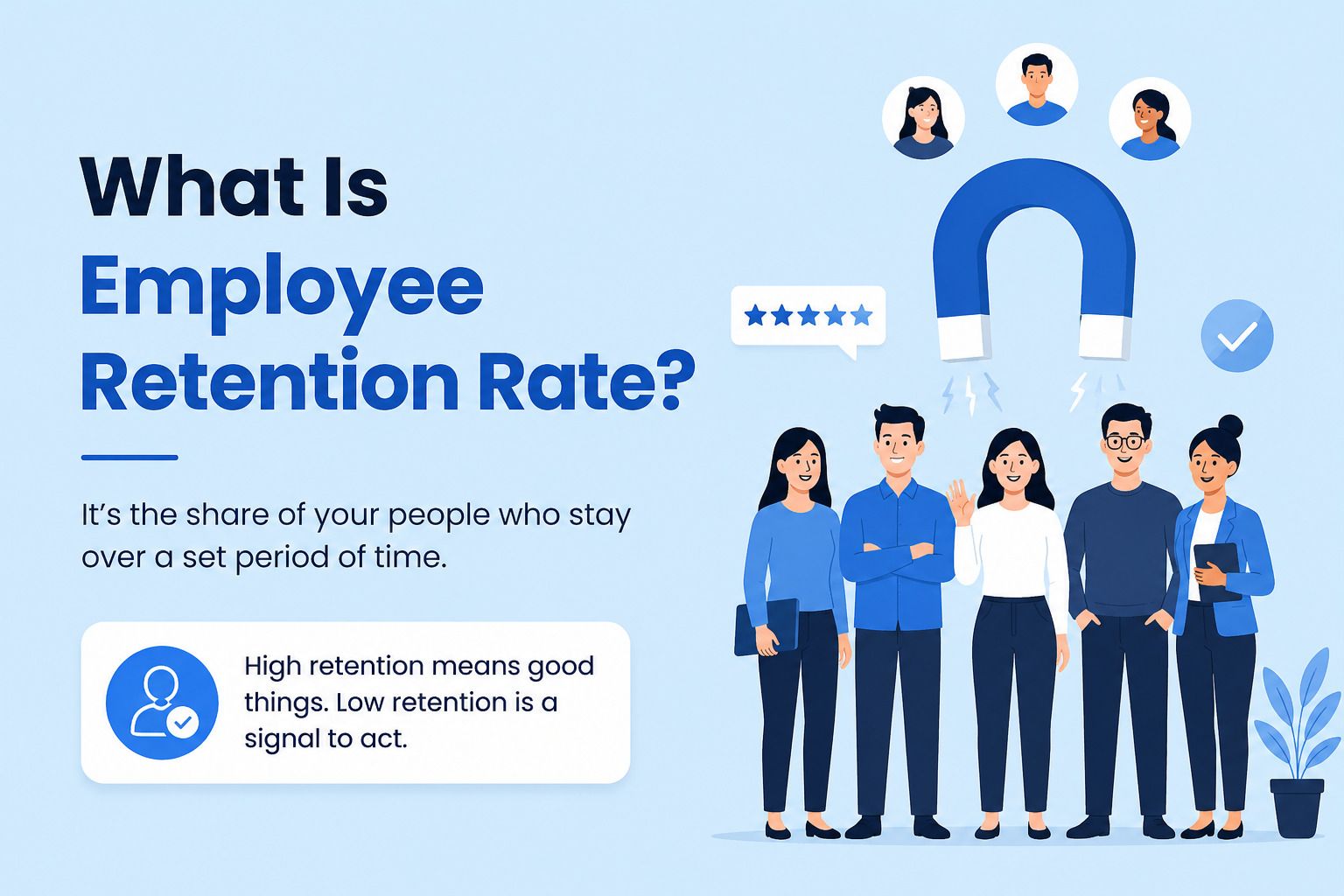
A high employee retention rate usually reflects competitive compensation, supportive leadership, career growth opportunities, and a positive workplace culture. On the other hand, a low retention rate can signal issues such as poor management, limited career progression, burnout, or low employee satisfaction. Whether you call it staff retention, talent retention, or workforce retention, the goal remains the same, retaining skilled employees by improving the overall employee experience. Strong employee engagement plays a crucial role, as engaged employees are more likely to stay and contribute to long-term business success. Since employee retention and employee turnover measure opposite sides of the same workforce trend, tracking both metrics provides a more complete picture of organizational health and retention performance.
How to Calculate Employee Retention Rate
Get the math right, and everything downstream makes sense. Get it wrong, and you're making decisions based on a number that doesn't reflect reality. That's why it's essential to accurately calculate the employee retention rate before making workforce decisions. An HRMS ROI Calculator can also help organizations measure how improved employee retention contributes to cost savings and the overall return on investment from their HR technology. So, let's nail down how to properly calculate the employee retention rate.
The Basic Retention Rate Formula
Here's the employee retention rate formula, and it's friendlier than it looks:
Employee Retention Rate (%) = (Employees who stayed the whole period ÷ Headcount at the start) × 100
Three habits keep your employee retention rate calculation honest:
- Pick a window and stick to it for a month, a quarter, a year.
- Use the headcount you had at the start as the bottom number.
- Leave new hires out of it. Retention is about keeping the people you already have, not padding the count with fresh faces.
Let's do an employee retention rate example.
Say you kicked off the year with 200 people, and 30 of them left. That leaves 170: (170 ÷ 200) × 100 = 85%
So your annual employee retention rate is 85%. Now a trickier one. You start Q1 with 50 staff, hire 10 during the quarter, but 5 of your original crew leave. You only count those original 50: ((50 − 5) ÷ 50) × 100 = 90%
Those 10 new hires don't belong here. They get tracked separately in something called new-hire retention, which we'll touch on shortly.
Common Calculation Mistakes to Avoid
Most dodgy retention numbers aren't a math problem. They're a "what did you actually count" problem. Here's where people slip up:
- Sneaking new hires into the top number. This inflates your rate and makes you feel better than you should. Don't.
- Confusing starting headcount with average headcount. The retention rate formula uses your starting number. The employee turnover rate formula usually uses the average. Mix them up, and your two figures stop agreeing with each other.
- Treating transfers as exits. Someone who moves from marketing to sales hasn't left the company. They might vanish from a department report, but at the org level, they're retained.
- Mergers and acquisitions. When headcount doubles overnight because you bought another firm, dumping everyone into one rate hides what's really happening. Track the acquired team on its own for a while.
- Part-timers, contractors, and seasonal staff. Decide early whether they're in or out. A wave of seasonal departures in retail can tank an otherwise healthy figure, so a lot of companies report them on the side.
- Forgetting the time frame. A 95% monthly retention rate and a 95% annual retention rate are not the same. Always specify the period you're measuring to avoid misleading conclusions. Accurate timesheet software and workforce tracking can help HR teams maintain reliable employee records and calculate retention metrics consistently across different reporting periods.
Voluntary vs Involuntary Turnover in Your Calculation
The employee turnover rate formula provides an overall turnover figure, but understanding the reasons behind employee departures is equally important. Voluntary turnover, where employees resign, is often preventable and serves as a key indicator of the effectiveness of your employee retention efforts. Involuntary turnover, including layoffs and terminations, is typically driven by business or performance decisions. It's also important to distinguish between employee attrition rate and turnover, attrition refers to voluntary departures where positions are not replaced, while turnover usually involves replacing employees. A robust HR management system helps organizations track voluntary turnover, involuntary turnover, and attrition separately, enabling better workforce planning and more informed HR decisions.
What Is a Good Employee Retention Rate?
There's no magic universal number, but as a 2026 rule of thumb, most companies aim for an annual employee retention rate of 85–90%, while anything above 90% is generally considered excellent. In other words, that translates to a turnover rate in the low double digits or lower.
In the US, Mercer's recent turnover research found average voluntary turnover at around 13%, down from approximately 17% in 2023 and 25% in 2022. This means the average employee retention rate has moved into the high 80s heading into 2026, although benchmarks still vary significantly by industry, role, and region. Using an HRMS alongside performance management software enables organizations to monitor retention trends, identify high-performing employees at risk of leaving, and implement data-driven strategies to improve workforce stability over time.
Retention Rate Benchmarks by Industry
Any employee retention rate benchmark is a starting line, not a finish line. Turnover swings hard depending on the sector you're in:
Industry | Typical annual turnover | Retention tendency |
|---|---|---|
Government, education, finance | Low (~10–15%) | Very steady |
Professional services / tech | Moderate (~20–25%) | Improving lately |
Manufacturing | Moderate–high (~24–32%) | Depends on the role |
Retail & wholesale | High (~25–27%) | Tougher to hold |
Hospitality & food service | Highest (often 50%+) | The hardest of all |
Context is everything. A retailer at 75% retention might be crushing its sector average, while a finance firm at 85% could actually be lagging behind its peers. Always read your number against the right employee retention rate benchmark for your world, not someone else's.
Regional Differences: Employee Retention in the UAE and Beyond
Employee retention in the UAE is influenced by factors such as competitive compensation, tax-free income, high living standards, and strong career growth opportunities, contributing to a healthy average employee retention rate. However, industries like hospitality and retail often experience higher turnover due to seasonal hiring and a mobile expatriate workforce, making structured employee retention programs essential. Organizations with hybrid or remote work models may also see stronger retention than fully office-based teams. Rather than relying only on national averages, businesses should benchmark retention across departments, locations, and employee segments. An integrated HRMS helps track retention trends, support workforce planning, and enable data-driven decisions that improve long-term employee retention.
How Company Size Affects Retention Expectations
Industry charts skip a big factor: how big you are.
If you're a small business with fewer than 50 employees, a single resignation can significantly impact your retention rate, making monthly figures appear volatile—and that's perfectly normal. Smaller organizations often compete through culture, flexibility, and autonomy rather than extensive benefits. Mid-sized companies with 50 to 500 employees typically see more stable retention metrics, but this is also where career progression challenges can emerge as employees outgrow flatter organizational structures. Larger enterprises with 500+ employees generally report steadier retention rates, although company-wide averages can sometimes hide high turnover within specific departments or business units. Using Onboarding and Offboarding Checklists for HR in the UAE helps organizations of all sizes standardize employee transitions, improve the employee experience, and identify retention issues before they become larger workforce challenges.
The point: set targets for your size before you go comparing yourself to some Fortune 500 benchmark.
When High Retention Becomes a Problem
Here's something people rarely admit. Retention that's too high can be a warning sign, not a trophy. If basically nobody ever leaves, you might be looking at stagnation, with little fresh thinking coming through the door. You might have ambitious people stuck behind colleagues who'll never move. Or, frankly, you might be hanging on to underperformers because managers keep dodging hard conversations.
Healthy teams expect a certain level of positive turnover, where lower-performing employees move on, creating opportunities for new talent and fresh perspectives. The goal of an effective employee retention strategy isn't to achieve a perfect 100% retention rate, it's to retain high-performing employees while allowing for healthy workforce movement. When evaluating HR solutions, consider pricing alongside features to ensure your investment supports long-term employee retention, performance management, and overall workforce success.
Analyzing Your Retention Rate for Actionable Insights
One company-wide number tells you something's wrong. It doesn't tell you where. That's where the real employee retention metrics earn their keep.
- Cohort Retention Analysis
Instead of relying on one blended figure, analyze employee retention by cohort, hire date, department, role, location, and manager. Breaking retention down this way reveals patterns that an overall average can easily hide. For example, your organization may have an overall retention rate of 88%, while one manager's team is experiencing a 70% retention rate, or employees hired during a rapid expansion may consistently leave within 18 months. That's the difference between a number that's merely interesting and one that drives meaningful action. Using Payroll HRMS Software in UAE enables organizations to segment workforce data, monitor retention trends across different employee groups, and make informed decisions based on real-time HR analytics.
- First-Year vs Long-Term Retention Patterns
Retention problems look different depending on how long someone's been around, and each stage needs its own fix.
In the first year, early exits usually scream onboarding trouble or a gap between the job you advertised and the job people actually got. Watch your 90-day and first-year retention closely here. Between one and three years, departures tend to be about career paths drying up or pay falling behind the market. And after three-plus years, losing someone really hurts; those are the folks carrying your institutional knowledge and the relationships nobody else has. Figuring out how to improve the employee retention rate starts with spotting which of these bands is actually leaking.
- Early Warning Indicators of Turnover Risk
The best retention work happens before an employee submits their resignation, not after. By the time the resignation letter arrives, the opportunity to retain that employee has often passed. Instead, watch for early warning signs such as declining engagement scores, increasing absenteeism, reduced productivity, quieter participation in meetings, or a previously enthusiastic employee withdrawing from projects. Pair these signals with cohort-based retention data to identify at-risk employees and start meaningful stay interviews while there's still time to make a difference. Tracking workload and using an Overtime Pay Calculator can also help identify employees who are consistently working excessive hours, reducing the risk of burnout and improving long-term retention. That's one of the most effective ways to reduce employee turnover.
How Retention Rate Impacts Business Performance
Retention isn't just an HR scorecard. It shows up in the actual business. Nudge your employee retention rate up a few points, and you'll feel it in lower replacement costs. Remember, every exit can run 50% to 400% of salary. You'll feel it in productivity, because settled teams keep their momentum instead of restarting projects every time someone leaves. Customers notice too, people who've been around know your systems and your accounts, and that loyalty shows up in satisfaction scores.
Then there's the knowledge that long-tenured staff carries, the kind that connects dots a newcomer can't even see yet. And a reputation for keeping people quiet does your recruiting for you, pulling in better candidates without the agency fees. No surprise, then, that engaged, high-retention workforces keep getting linked to stronger profits, which is exactly why retention rate now sits alongside revenue as a genuine employee retention KPI.
Strategies to Improve Employee Retention Rate
Knowing your employee retention rate is only the first step—the real impact comes from improving it with the right strategies. Start by offering competitive compensation, investing in manager development, and creating clear career paths supported by continuous learning and development opportunities. Recognizing employee contributions, providing workplace flexibility, and conducting regular stay interviews also help strengthen employee loyalty and reduce turnover. Build a comprehensive employee retention program with structured onboarding, continuous feedback, employee well-being initiatives, and regular engagement surveys. Using employee engagement software enables organizations to collect real-time feedback, measure engagement, and identify potential retention risks before they lead to employee turnover. By consistently applying these employee retention best practices, businesses can improve employee satisfaction, retain top talent, and build a more engaged and productive workforce.
Tracking and Reporting Retention Rate
Tracking the employee retention rate once a year isn't enough. Measure it quarterly and monitor key employee retention metrics such as voluntary turnover, new-hire retention, average tenure, and employee engagement every month to identify trends early. Segment your data by department, manager, tenure, and location to uncover actionable insights and improve decision-making. Integrating learning and development initiatives with recruitment and performance data helps organizations close skill gaps, support employee growth, and strengthen long-term retention. Most importantly, use your retention data to create actionable strategies that improve employee experience, reduce turnover, and drive sustainable business success.
Conclusion
The employee retention rate is more than just a number, it reflects how well your organization supports, engages, and retains its workforce. By understanding the employee retention rate formula, measuring retention consistently, and comparing your results against industry benchmarks, you can identify areas for improvement and make informed HR decisions. Implementing effective employee retention strategies, such as structured onboarding, continuous learning opportunities, fair compensation, employee recognition, supportive leadership, and flexible work policies, can significantly reduce turnover while improving productivity and employee satisfaction. Leveraging the right HR technology can further simplify these efforts. Zimyo helps businesses streamline onboarding, performance management, employee engagement, payroll, and workforce analytics, making it easier to build a workplace where employees choose to stay. Remember, retaining skilled employees is not just about reducing hiring costs, it's about creating a positive workplace culture, strengthening business performance, and driving sustainable long-term growth.