
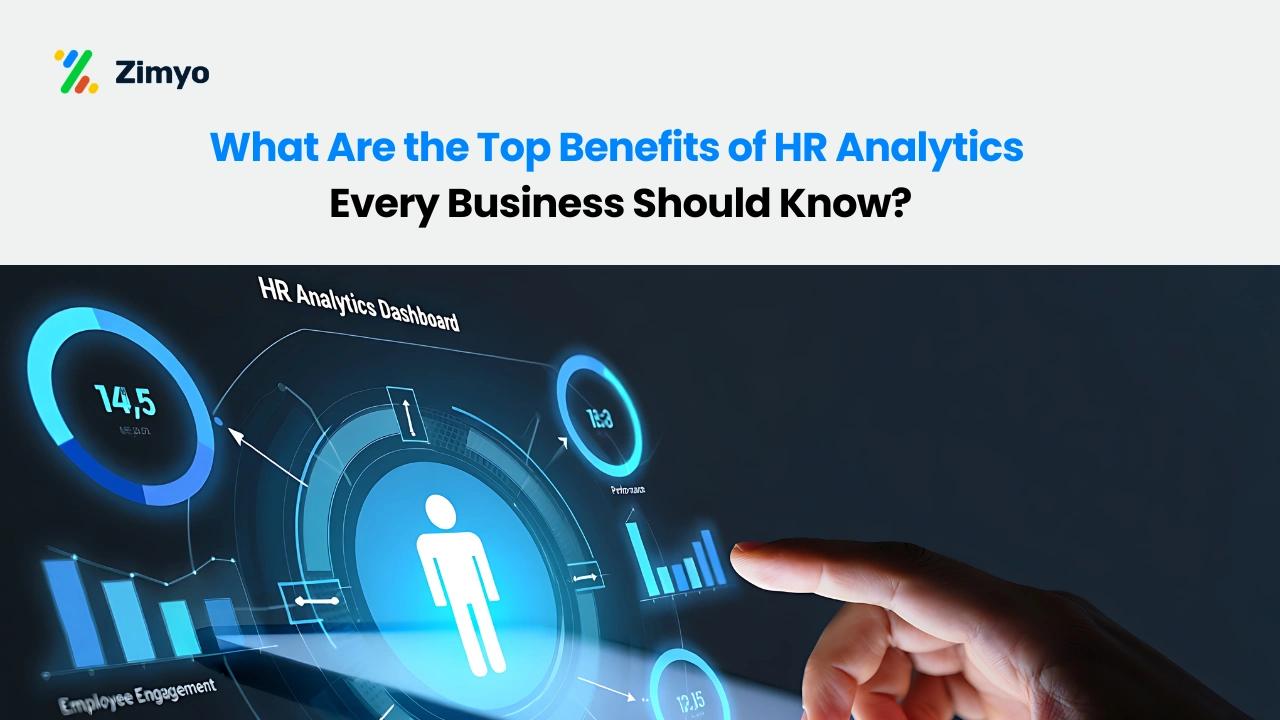
Businesses today cannot afford to make HR decisions based on assumptions alone. With rising hiring costs, increasing competition for skilled talent, and workforce nationalization initiatives across the UAE, Saudi Arabia, and the wider GCC, organizations need reliable data to make smarter people decisions. This is where the Benefits of HR Analytics become evident. From improving hiring quality and reducing employee turnover to optimizing workforce planning, HR analytics helps businesses turn workforce data into measurable business outcomes. This also highlights the Importance of HR Analytics in building a productive, future-ready workforce that supports long-term business growth.
This guide goes past the usual "10 benefits" list. You will get the four maturity levels, the HR analytics KPIs that matter, a simple ROI method, regional HR analytics use cases, a realistic rollout plan, the tools worth buying, and the mistakes that quietly sink most projects.
Key Takeaways
In this blog, we'll explain:
- What HR analytics is and its four maturity levels
- The core benefits, from recruitment and retention to nationalization and cost
- The key HR analytics KPIs to track and how to prove ROI
- The tools you need and a step-by-step rollout roadmap
- Data governance in the GCC and why most initiatives fail
What Is HR Analytics?
HR analytics is the process of transforming employee data into meaningful insights that help organizations make smarter, data-driven workforce decisions. You will hear it called People analytics, Human resource analytics, or Workforce analytics, and sometimes HR data analytics, Employee analytics, or Talent analytics. Different labels, same idea: using data to improve how you hire, develop, and retain employees. When combined with modern HR management software, HR analytics enables businesses to make faster, more informed workforce decisions.
There is one distinction worth clearing up early. HR metrics are single measurements, like your turnover rate or time to fill a vacancy. HR analytics is what you get when you connect those HR metrics to spot patterns, explain the causes, and predict what happens next. A metric reports what happened. Analytics tells you why, and points you toward what to do about it.
The Four Types of HR Analytics (A Maturity Progression)
Most "what is HR analytics" explainers stop at the definition. The four maturity levels are far more useful because they show you where you stand today and what to build next.
- Descriptive analytics- what happened: Headcount, turnover, time to fill, absenteeism, and yes, your Saudization or Emiratization ratio. This is the reporting layer, everything else sits on.
- Diagnostic analytics- why it happened: Digging into root causes. You might find that resignations cluster among employees who have been passed over for promotion for two years or more.
- Predictive analytics – what is likely to happen: Using past patterns to forecast future outcomes, such as flight-risk scoring that flags employees 60 to 90 days before they resign. It can also identify skill gaps and training needs, enabling organizations to deliver targeted learning through a Learning Management System (LMS) before performance or retention is affected.
- Prescriptive analytics- what to do about it: Recommending a specific move, such as a stay conversation, a pay review, or a lighter workload, and estimating the likely impact.
A word of caution that regional HR teams learn the hard way: don't chase predictive people analytics while your basic data is a mess. Maturity is a ladder. Get clean, trustworthy reporting sorted first, then climb.
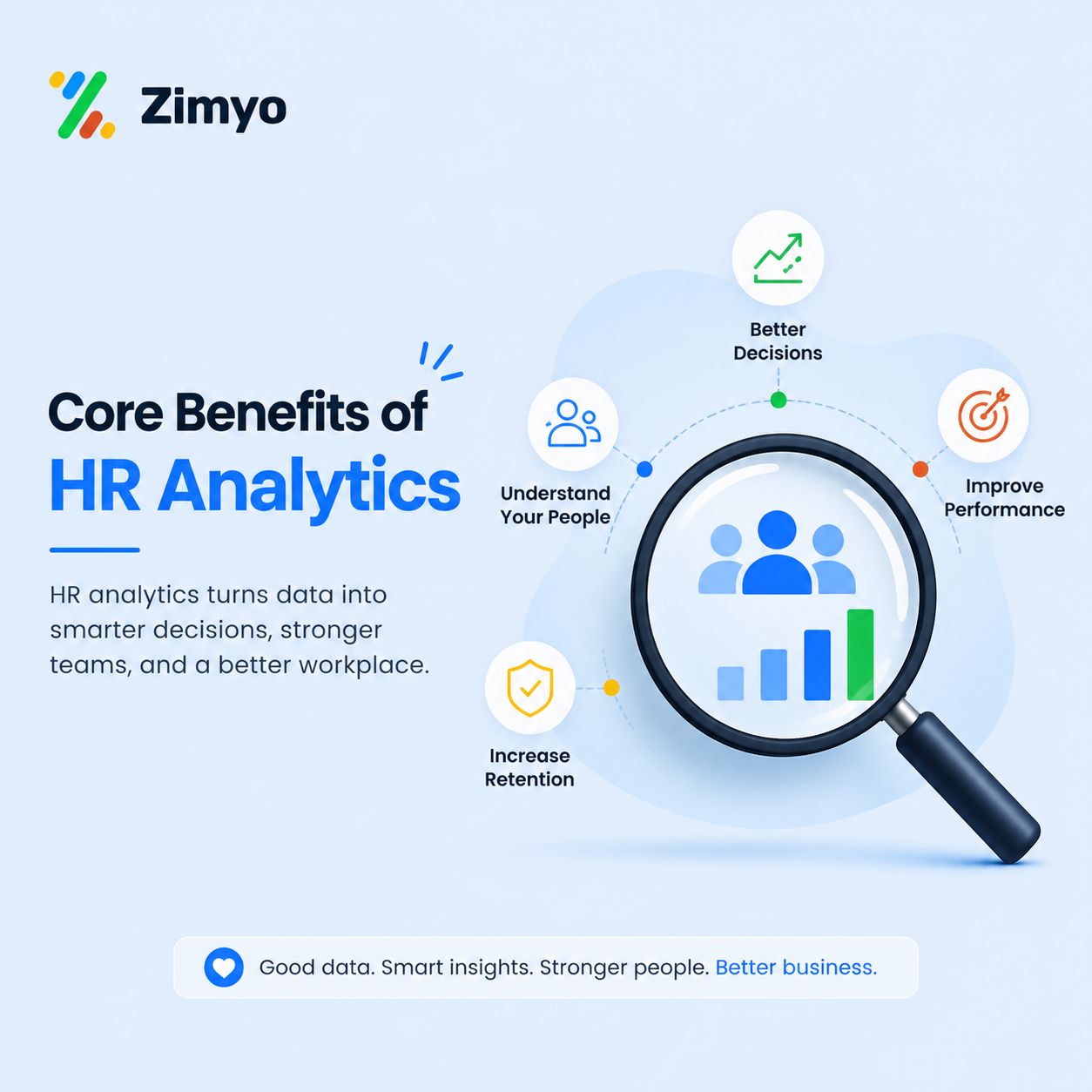
Core Benefits of HR Analytics
Here are the advantages that matter most, with the depth competitors tend to skip. Treat these as practical HR analytics examples you can put to work.
1. Smarter Recruitment and Better Quality of Hire
The benefits of HR analytics in recruitment go well beyond counting applicants. They come from optimizing the right metric, and the best one is Quality of Hire, usually built from a blend of post-hire signals:
Quality of Hire = (Performance Score + Retention after 12 months + Ramp-to-Productivity Score) ÷ Number of factors
Source analysis then shows which channels produce hires who actually perform, not just those who apply quickest, which is invaluable in a market where recruiters rely on job portals, local job boards, global agencies, and employee referrals. Talent analytics also reveals where qualified candidates drop out of the hiring funnel and helps reduce bias during the shortlisting process.
2. Lower Turnover Through Predictive Retention
Predictive retention is one of the biggest Benefits of HR Analytics for businesses. By using Employee analytics, People analytics, and HR data analytics, organizations can identify employees who are at risk of leaving based on factors such as engagement, tenure, absenteeism, and performance. This allows HR teams to take proactive retention measures, reduce unwanted turnover, and retain top talent. Among all HR analytics use cases, this delivers one of the strongest returns and highlights the Importance of HR Analytics in data-driven HR and in improving HR analytics for decision-making.
3. Workforce Planning and Nationalization Targets
Here is where the Gulf story really differs. Beyond forecasting hiring needs and skills gaps, workforce analytics has become essential for meeting nationalization goals under programs like Nitaqat in Saudi Arabia and Emiratisation in the UAE, with similar schemes in Oman, Qatar, and Bahrain. It also helps organizations stay aligned with the UAE Labor Law by monitoring workforce composition, hiring trends, and compliance requirements. Analytics lets you track your national-to-expat ratio in real time, model how hiring or restructuring plans affect compliance, and identify why national employees leave so you can improve retention. Getting this right supports Vision 2030 and similar economic diversification initiatives across the region.
4. Stronger Engagement and Employee Experience
Engagement is notoriously hard to read at first glance, and only about a third of the workforce is highly engaged at any given time. People analytics replaces the once-a-year survey with continuous listening through pulse checks and sentiment analysis, giving you a real-time read on morale across offices, sites, and nationalities. That last point matters in the GCC, where a single team might span a dozen cultures. Tie engagement to outcomes, and the payoff is concrete: firms using advanced analytics report stronger productivity than their peers.
5. Cost Control and Financial Impact
Beyond retention savings, analytics surfaces costs hiding in plain sight, including overtime spikes that hint at understaffing, unused benefits, and bloated reporting lines. Tracking the Employee Retention Rate alongside other HR metrics helps organizations identify workforce trends and measure the success of their retention strategies. Reported ROI across HR analytics use cases typically ranges from 187% to 421%, with retention and recruitment delivering the highest returns. Cloud-based HR analytics software also provides faster, more cost-effective insights than the legacy systems many regional businesses still rely on.
6. Fairer Pay and DEI Progress You Can Prove
Data makes fairness measurable. HR analytics supports pay-equity reviews, representation tracking across levels and departments, and checks for where certain groups drop out of the hiring funnel. In a workforce as diverse as the region's, being able to monitor and prove fair practice is both a governance win and an employer-brand advantage.
HR Analytics for Decision Making: Building the ROI Case
Everyone claims HR analytics "saves money." Almost nobody shows the math. Since HR analytics for decision making only wins budget when you can prove a return, here is a simple way to make the case to your CFO. You can also use a View Calculators option to estimate potential cost savings and ROI based on your workforce data.
Start by pricing the problem. Take turnover:
Annual turnover cost = Employees lost × Average replacement cost e.g., 75 employees × SAR 560,000 ≈ SAR 42M / year
Then estimate a realistic fix. Cut regrettable turnover by 20% and you have avoided roughly SAR 8.4 M in losses. Add up the investment (software, setup, an analyst's time, training), and run the return:
ROI (%) = [(Annual benefit − Annual cost) ÷ Annual cost] × 100
Don't forget the softer gains either, like faster hiring, less HR admin, and cleaner workforce planning. Report these wins loudly, because many finance leaders still see HR analytics as a cost center until the return is on the table. Mature programs have reported an average ROI near 367% within two years.
10 Benefits of Tracking Essential HR Analytics Metrics and KPIs
Track fewer HR metrics, but the right ones. These are the HR analytics KPIs worth your attention, with how each is measured:
KPI | What it measures | Formula / basis |
|---|---|---|
Turnover Rate | Workforce stability | (Separations ÷ Avg headcount) × 100 |
Regrettable vs. Non-Regrettable Turnover | Loss of wanted talent | Segment exits by performance/intent |
Nationalization Ratio | Saudization / Emiratization compliance | National headcount ÷ Total headcount |
Quality of Hire | Hiring effectiveness | Avg of performance, retention, ramp scores |
Time to Fill / Time to Hire | Recruiting speed | Days from req-open (or apply) to accept |
Cost per Hire | Recruiting efficiency | Total hiring costs ÷ Number of hires |
eNPS | Loyalty & advocacy | % Promoters − % Detractors |
Absenteeism Rate | Early burnout signal | (Absent days ÷ Total workdays) × 100 |
Internal Mobility Rate | Talent development | Internal moves ÷ Total roles filled |
Training ROI | Learning impact | (Value gained − L&D cost) ÷ L&D cost |
Let your goals decide what to prioritize. A fast-scaling Dubai startup watches Time to Fill and Quality of Hire. A large Saudi employer keeps a close eye on the Nationalization Ratio and Regrettable Turnover. Businesses in the UAE may also combine workforce insights with tools like a UAE Gratuity Calculator to support workforce planning and employee cost forecasting. Whatever the mix, these belong on a live HR dashboard, not buried in a slide deck nobody reopens. A good HR dashboard is what turns raw HR metrics into decisions people actually make.
Technology and Tools: What You Actually Need
The HR analytics tools market confuses people because vendors blur the categories. Here is the stack, plainly:
- HRIS / HCM (the data source): your system of record. If the data here is messy, nothing downstream works.
- People-analytics platforms (the engine): purpose-built HR analytics software that connects your sources, builds models, and surfaces insight.
- BI / visualization tools (the display layer): they turn all of it into an HR dashboard anyone can read.
- Data-science software (the deep end): only needed when you are building custom predictive models in-house.
The factor that makes or breaks the whole thing is integration. Siloed HR data analytics spread across legacy and localized payroll management systems is one of the biggest barriers to value in the region. One more consideration for GCC buyers: check where the tool hosts your data, because data-residency rules increasingly favor keeping employee records in-Kingdom or in-country.
How to Use HR Analytics: A Practical Roadmap
Knowing how to use HR analytics is mostly about sequence. You don't begin with AI. You begin with discipline.
- Phase 1- foundation, months 1 to 3. Manual reporting and basic descriptive metrics. First, agree on a single source of truth and shared definitions. What counts as a "termination" when you have secondments and visa transfers? Spreadsheets are fine at this stage.
- Phase 2- automation, months 4 to 9. Automated dashboards pulling live from your HRIS. First, validate data quality and get agreement on which KPIs matter.
- Phase 3- prediction, month 10 and beyond. Flight-risk models, scenario planning, sentiment analysis. First, you need a clean history, the right skills or a partner, and a use case with clear ROI.
Industry shapes the priorities. Retail leans on scheduling around peak seasons and Ramadan trading patterns. Tech and financial services in the DIFC and ADGM focus on retaining scarce senior talent, while healthcare monitors burnout and credential expiry. Smaller businesses don't need to copy the enterprise playbook; they can start with spreadsheets and gradually move to Payroll HRMS Software and advanced HR analytics tools as their workforce grows and the value becomes clear.
Data Privacy, Ethics, and Governance
The more powerful your workforce analytics gets, the more carefully you have to handle it, and the region's rules now have real teeth.
- Know your local law: Saudi Arabia's PDPL is fully enforceable and overseen by SDAIA, with fines of up to SAR 5 million per breach and a 72-hour window to report incidents that put people at risk. The UAE has its own federal data protection law, with separate regimes in the DIFC and ADGM, while Bahrain, Qatar, and Oman have introduced similar regulations. If you collect employee data for employee engagement, workforce analytics, or other HR initiatives, these laws apply even if your head office is located abroad.
- Watch for algorithmic bias: Predictive models can absorb and repeat historical bias. Audit them regularly.
- Empower, don't surveil: There is a clear line between helping employees and monitoring them. Cross it, and you lose the trust that the whole exercise depends on.
- Be transparent: Tell people what you collect and why. Governance isn't a brake on value here; it's a legal precondition for it.
HR Analytics Best Practices: Why Initiatives Fail
Most articles stay relentlessly upbeat. The reality is messier, and plenty of projects stall, rarely because of bad tools. Treat avoiding these as your core HR analytics best practices:
- Poor data quality: Cited by roughly 74% of organizations as the top barrier. Garbage in, garbage out.
- Analysis paralysis: Measuring everything and prioritizing nothing.
- Vanity metrics: Tracking what's easy instead of what drives a decision.
- Dashboard graveyards: Beautiful reports nobody acts on. Insight without action is just decoration.
- Manager resistance: Front-line leaders ignore data that contradicts their instincts unless you bring them along early.
- No ownership: Without a clear owner, the effort drifts. Technology doesn't create value. Adoption does.
Getting Started: Practical First Steps
Putting these HR analytics best practices into motion doesn't need a big budget or a data-science team:
- Audit your data quality first. You can't analyze what you can't trust.
- Pick one high-impact use case, such as regrettable attrition in a critical team, or your nationalization ratio.
- Secure an executive sponsor. Budget and credibility follow leadership backing.
- Build a small cross-functional team comprising HR, someone data-fluent, and a business leader to support workforce planning and performance management initiatives.
- Start descriptive, prove the value, then climb.
- Report the win loudly. Visible results unlock the next round of funding.
Conclusion
The Benefits of HR Analytics are no longer a nice-to-have, especially in a region reshaping its economic future. From predictive retention and smarter hiring to workforce planning and nationalization goals, data-driven HR delivers measurable business results. With an advanced HR analytics solution like Zimyo, businesses can turn workforce data into actionable insights and make faster, more informed decisions. Ultimately, this is why the Importance of HR Analytics continues to grow for organizations across the UAE, Saudi Arabia, and the wider GCC.
Just remember where the real advantage lives. Not in buying HR software, but in tracking the right HR analytics KPIs, proving the return, climbing the maturity ladder on purpose, and acting on what the data tells you. Start small, prove value, and grow from there. When talent is both your highest cost and your biggest opportunity, HR analytics is how forward-looking businesses across the Gulf turn people data into a genuine edge.