
The best HR systems in the Middle East do payroll accurately in all countries where you have operations, are fully supported in Arabic and English, and integrate HR, Attendance, and Payroll modules into one Employee module. The best options for 2027 include Zimyo for SMEs and mid-sized organizations in the GCC region, ZenHR for multinationals in the MENA region, Jisr for organizations operating only in Saudi Arabia, Bayzat for UAE companies wanting to have integrated HR and Health Insurance modules, and SAP SuccessFactors/Workday for global companies.
Middle East HR Software Compared
| Software | Best for | Coverage | Pricing |
|---|---|---|---|
| Zimyo | GCC SMEs and mid-market, multi-country | UAE, KSA, Qatar, Kuwait, Bahrain, Oman, Egypt | From AED 10/user/month |
| Bayzat | UAE SMEs wanting HR + health insurance | UAE, KSA | Custom quote |
| ZenHR | Multi-country MENA payroll | 11 MENA countries | Quote per organisation |
| Jisr | Saudi-only businesses | Saudi Arabia | Quote; free trial |
| Darwinbox | Enterprises across Asia and the Gulf | GCC and Asia | Custom quote |
| MenaITech | Modular, long-established MENA suite | MENA | Per active employee |
| Yomly | UAE enterprises with 250+ staff | UAE and GCC | Custom quote |
| gulfHR | UAE firms needing cloud or on-premises | UAE, KSA, Egypt | Custom quote |
| SAP SuccessFactors | Large SAP-invested enterprises | Global, Middle East localised | Enterprise pricing |
| Workday | Global enterprises, HR + finance | Global, UAE office | Enterprise pricing |
The 10 Best HR Software in the Middle East
1. Zimyo
Best for: GCC SMEs and mid-market companies running teams in more than one country
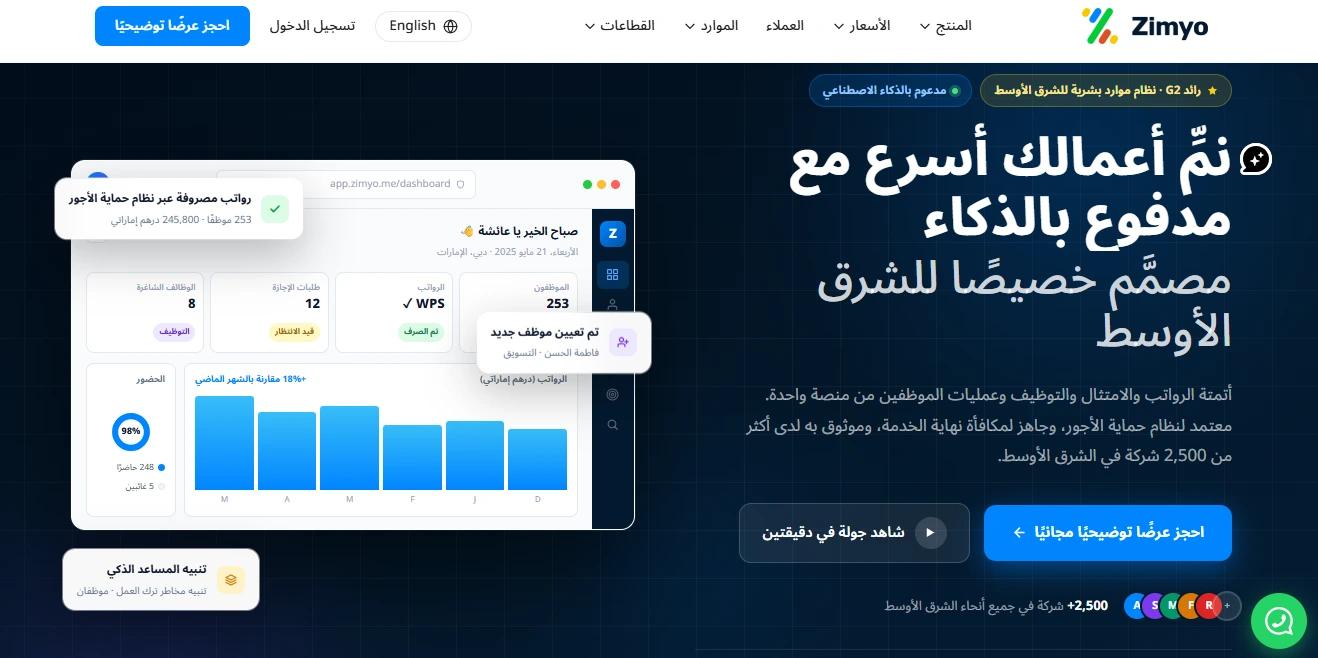
Zimyo is an AI-native HR and payroll platform founded in 2018 and used by 2,500+ organisations across 40+ countries. Its 60+ modules run on one employee record, so HR, attendance, payroll, performance, recruitment and learning share the same data instead of syncing between tools. On zimyo.me, the platform is localised for the UAE, Saudi Arabia, Qatar, Kuwait, Bahrain, Oman and Egypt, with plans priced in each country's own currency.
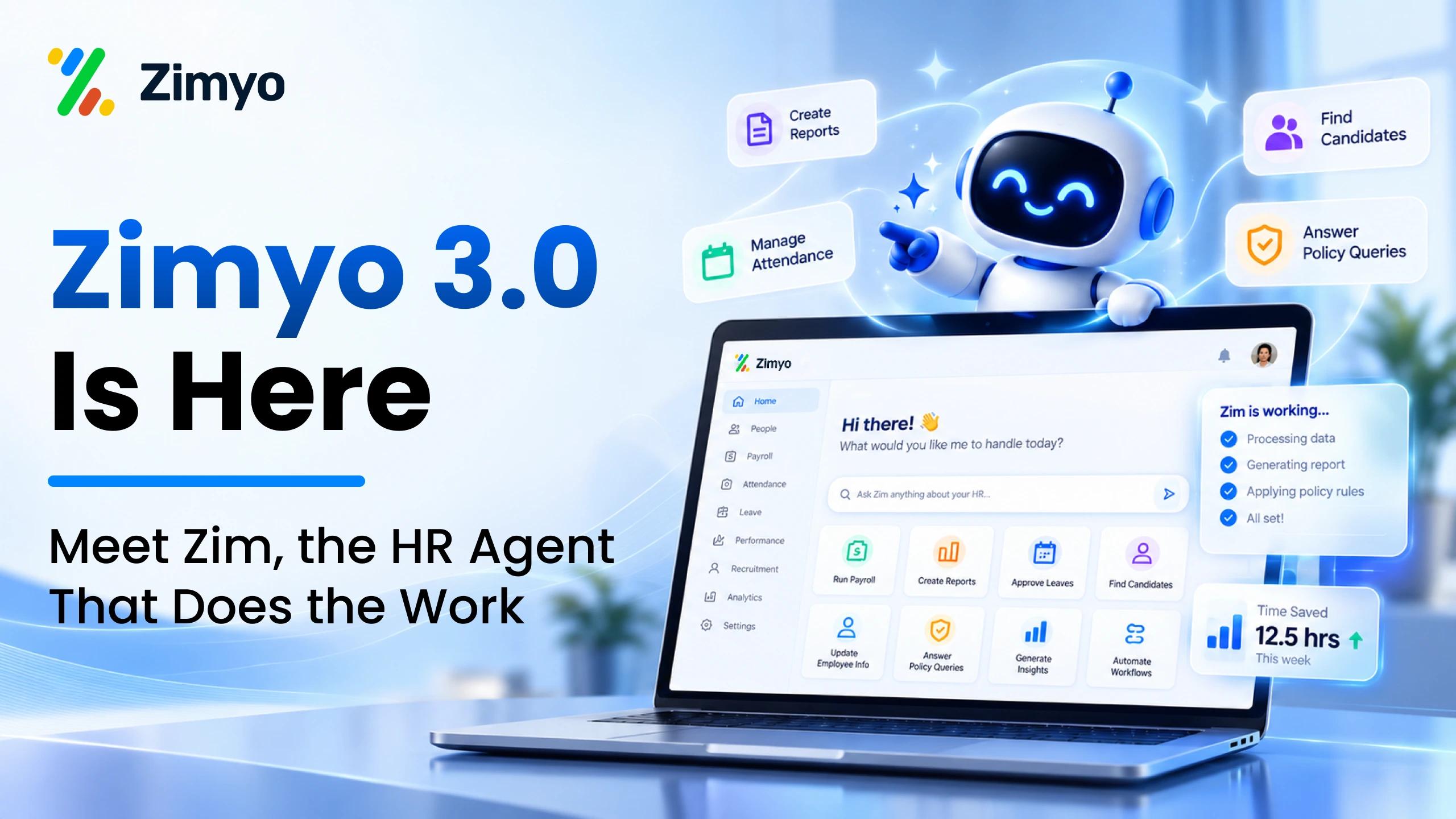
With Zimyo 3.0, launched in October 2026, Zimyo added Zim AI, an agentic framework that completes HR tasks rather than just answering questions. A helpdesk agent resolves payslip, leave and policy requests from live HRMS data, a payroll agent validates payroll runs and flags issues, and onboarding and performance agents handle new-hire paperwork and review drafts. Critical decisions still need human approval.
Strengths
- WPS-compliant payroll with SIF file generation and automated gratuity for the UAE
- GOSI, WPS payroll and insurance support for Saudi Arabia, with an Arabic interface
- Geofenced attendance, shifts and overtime for field and multi-site teams
- ISO 27001 certified, with GDPR-aligned data practices
Watch-outs
- No native Qiwa contract integration yet, so Saudi contract changes are still made in Qiwa directly.
- With 60+ modules, a phased rollout (core HR and payroll first) usually works better than switching everything on at once
Pricing: From AED 10 per user per month (Basic plan, minimum billing for 25 users). See UAE pricing or Saudi pricing.
2. Bayzat
Best for: UAE SMEs that want HR, payroll, and employee health insurance in one place
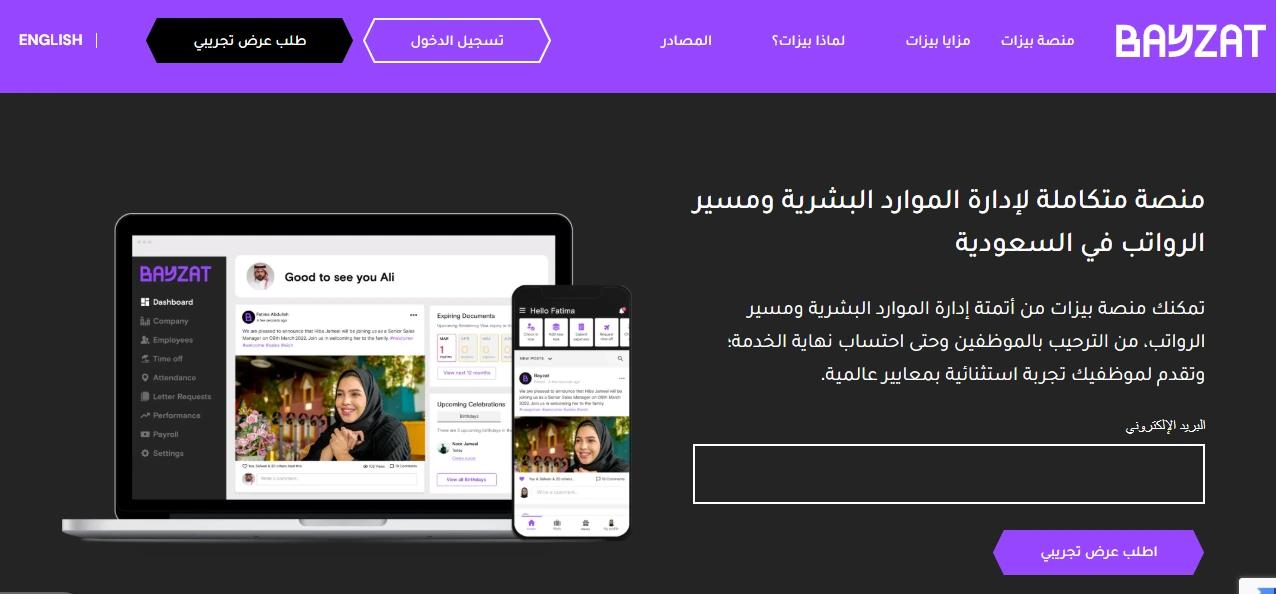
Bayzat is a Gulf-built HR and benefits platform with footholds in both the UAE and Saudi Arabia. Its plans cover core HR, payroll, attendance, benefits administration, and finance, with add-on modules on top. What sets it apart is insurance: Bayzat is a licensed insurance broker for employee health cover in the UAE so that companies can manage medical insurance alongside payroll.
Strengths
- HR, payroll, and employee health insurance managed from one platform
- ISO 27001 and SOC 2 certified
- Tiered per-employee plans with optional modules
Watch-outs
- Pricing is quote-based, so cost comparisons need a sales call
- Best fit when the UAE is the main market
Pricing: Per employee per month; custom quote based on headcount and modules.
3. ZenHR
Best for: Companies running payroll across several MENA countries
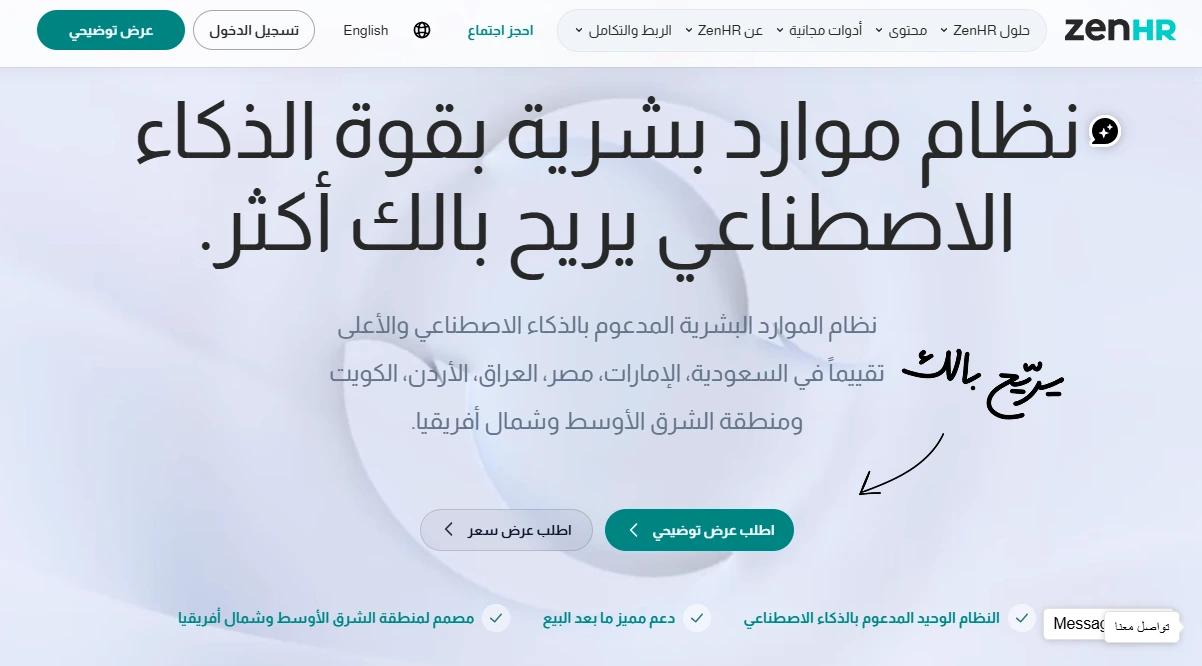
ZenHR started in Amman in 2016 and is now headquartered in Riyadh. It is fully localised for 11 MENA countries, covering labour law, social security and tax rules in each. In Saudi Arabia, it connects natively with Mudad, GOSI and Muqeem; in the UAE it generates WPS files and handles GPSSA contributions; and it covers Jordan's SSC and Kuwait's PIFSS.
Strengths
- Native Mudad, GOSI, and Muqeem integrations for Saudi Arabia
- Multi-country payroll for MENA entities in one system
- ZenATS applicant tracking built into the same platform
Watch-outs
- No published prices; quotes depend on bundle, headcount, and countries
- Some features depend on choosing the Advanced bundle over the Value bundle
Pricing: Quoted per organisation by bundle (Value or Advanced), headcount and countries.
4. Jisr
Best for: Businesses operating only in Saudi Arabia
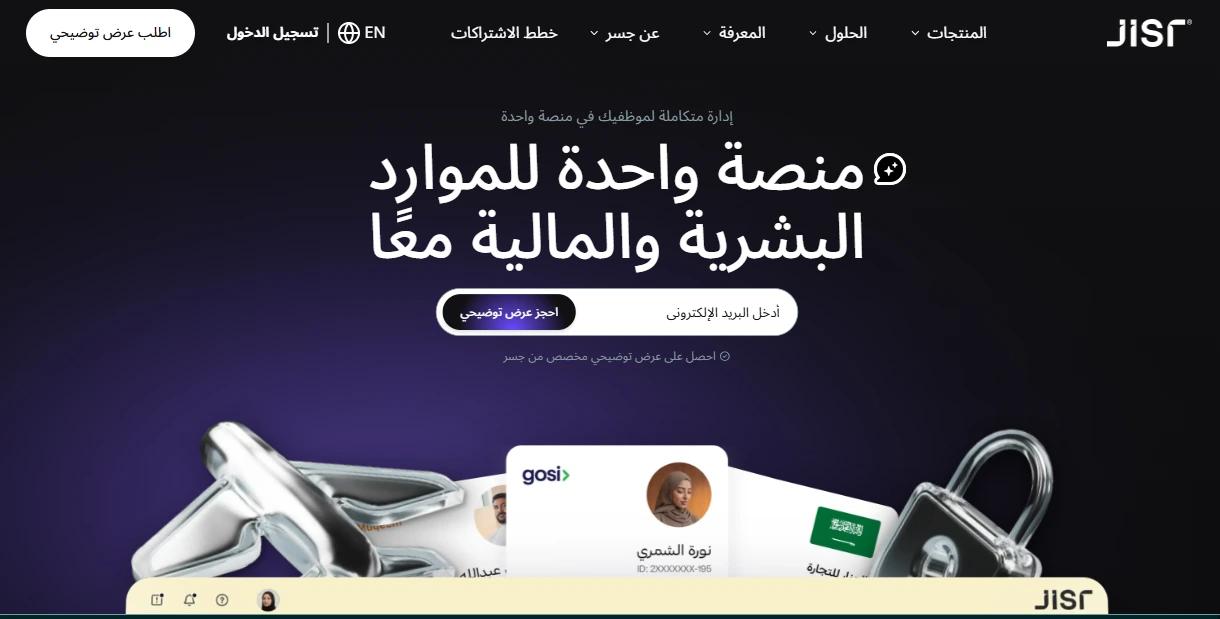
Jisr is a Saudi-native HR and payroll system built around the Kingdom's labour law and government platforms. Its payroll links to Mudad, GOSI, Muqeem, and local banks, and attendance data flows straight into payroll. Employees and managers raise and approve requests through the Jisr mobile app, and it integrates with accounting tools such as NetSuite and Xero.
Strengths
- Payroll connected to Mudad, GOSI, Muqeem, and banks
- Bilingual Arabic and English interface built for Saudi users
- Mobile app for requests and approvals
Watch-outs
- Built for Saudi Arabia only, so it doesn't suit multi-country GCC payroll
- Some user reviews flag reporting depth, so test reports during the demo
Pricing: Quote-based; free trial available.
5. Darwinbox
Best for: Large enterprises with operations across Asia and the Middle East
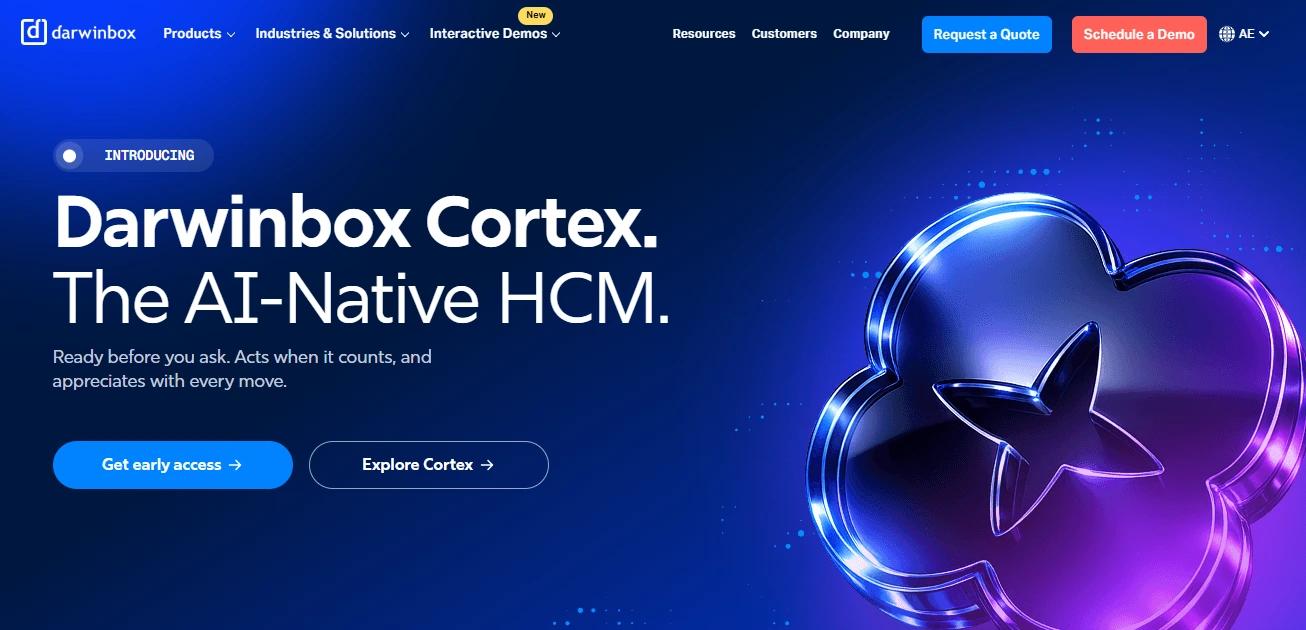
Darwinbox is an enterprise HCM platform that entered the Middle East with a Dubai base and has named Lulu Group and Aramex among its regional customers. It offers Arabic language support and configuration for local HR regulations, and its payroll module supports UAE WPS and Saudi GOSI. It suits large employers that want one HR system across Asian and Gulf entities.
Strengths
- Broad enterprise HCM suite covering talent, performance and analytics
- Strong fit for groups with entities in both Asia and the Gulf
- Mobile-first experience for large and deskless workforces
Watch-outs
- Confirm how deeply it integrates with Mudad and Qiwa before signing
- Enterprise implementations take longer than those of SME-focused tools
Pricing: Custom enterprise quote.
6. MenaITech
Best for: Organisations that want a modular, long-established MENA HR suite
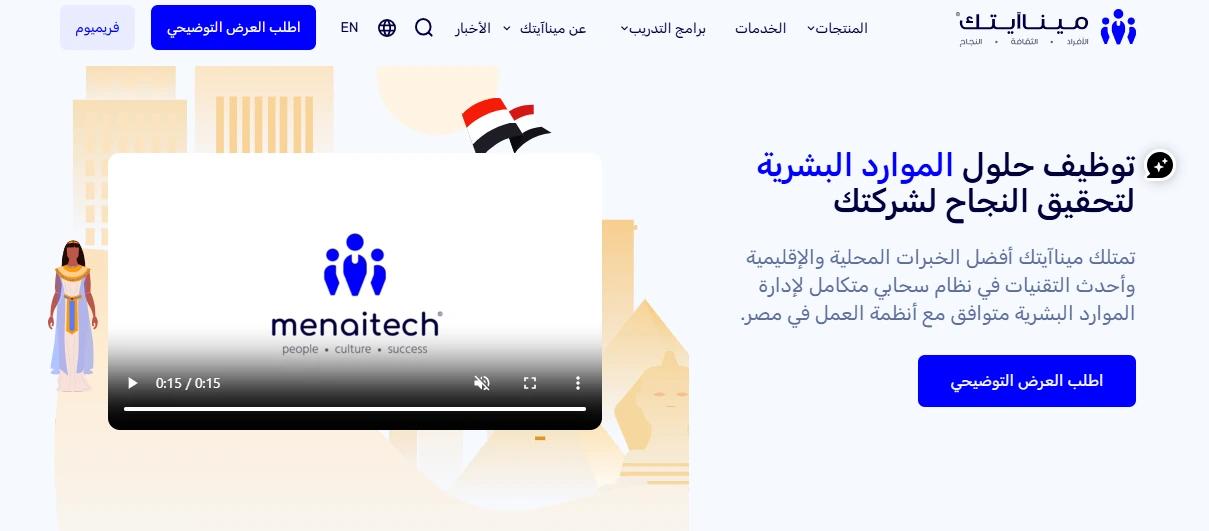
MenaITech is a Jordan-headquartered HR software company with a modular product family: MenaHR for HR management, MenaPAY for localised payroll, the MenaME-Plus app for employee and manager self-service, and MenaSME, a lighter cloud edition for small and medium businesses. All products run in Arabic and English, and its Saudi offering covers WPS, GOSI, and Mudad.
Strengths
- Localised payroll for MENA social security, tax, and currency rules
- Lighter SME edition alongside the full enterprise suite
- Cloud solutions priced per active employee
Watch-outs
- Several separately named modules, so clarify exactly what each bundle includes
- Pricing isn't published, so budgeting needs a sales conversation
Pricing: Per active employee; quote on request.
7. Yomly
Best for: UAE enterprises with 250+ employees
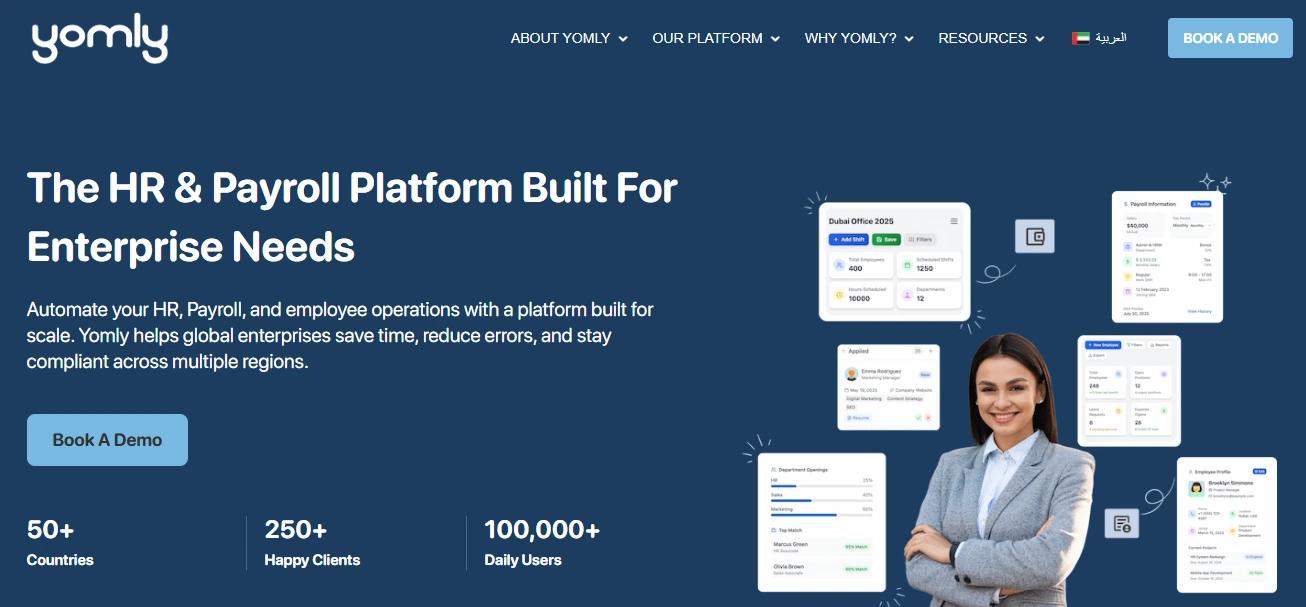
Yomly is a UAE-built HR and payroll platform aimed at larger organisations with complex or multi-branch workforces. It generates WPS SIF files, calculates gratuity, runs multi-currency payroll, and supports Arabic and English. Employee data is hosted in the UAE, and its customers include Kärcher, Nord Anglia Education and Lufthansa Technik Middle East.
Strengths
- Built for UAE labour law and enterprise-scale payroll
- UAE data hosting with role-based access control
- Multi-currency payroll with WPS and gratuity built in
Watch-outs
- Positioned for larger companies, so may be more than a small business needs
- Pricing is not published
Pricing: Custom, modular pricing based on headcount and modules.
8. gulfHR
Best for: Mid-to-large UAE companies that want an established, flexible deployment
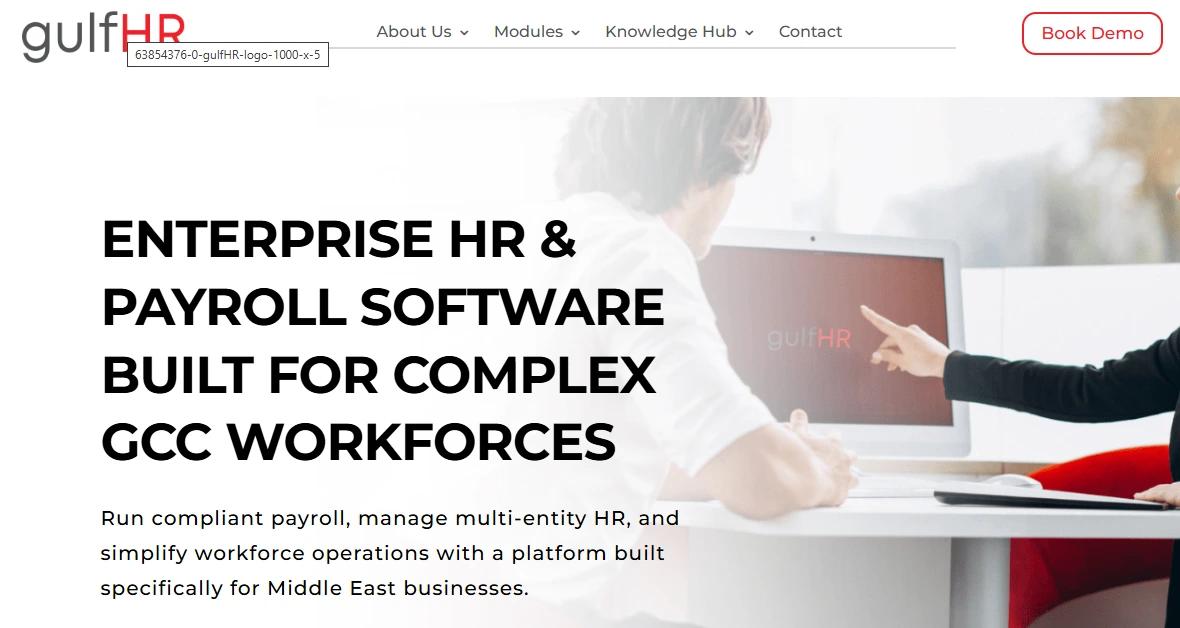
gulfHR is a Dubai-based HR and payroll provider that has served companies in the UAE, Saudi Arabia, and Egypt since 2003. It handles WPS, end-of-service calculations and visa tracking, runs in Arabic and English, and can be deployed in the cloud or on-premises, which matters for organisations with strict IT policies.
Strengths
- Over two decades of GCC payroll experience
- Cloud or on-premises deployment
- Visa and document tracking for expat workforces
Watch-outs
- Aimed at organisations that have outgrown basic HR tools, so may be more than a startup needs
- Pricing isn't published
Pricing: Custom quote based on company size and modules.
9. SAP SuccessFactors
Best for: Large enterprises already invested in SAP
SAP SuccessFactors is a global HCM suite used by large organisations across the Gulf. Employee Central Payroll includes localisations for major Middle East markets. It can model complex pay and statutory rules, which suits groups that already run SAP for finance and want HR on the same backbone.
Strengths
- Deep payroll capability with Middle East localisations
- Tight integration with SAP finance and ERP
- Mature talent, learning and succession modules
Watch-outs
- Implementation usually runs through SAP partners and takes months
- Cost and complexity are high for small and mid-sized firms
Pricing: Enterprise pricing through SAP or its partners.
10. Workday
Best for: Global enterprises that want HR and finance on one platform
Workday launched operations in the UAE in October 2026, opening a Dubai office with dedicated regional teams. It combines HR, finance, and AI agents on one data model. In the UAE, its payroll service is delivered partly through its partner Remote, which handles monthly WPS and SIF submissions.
Strengths
- Unified HR and finance data model
- Strong analytics and workforce planning
- New local presence in Dubai
Watch-outs
- Regional payroll relies partly on partners, so confirm Saudi and wider GCC coverage
- Built and priced for large enterprises
Pricing: Enterprise pricing on request.
How We Chose These Tools
We looked at the HR platforms Middle East buyers compare most often and kept the ten that best met five criteria: depth of payroll compliance in the UAE and Saudi Arabia, genuine Arabic and English support, ability to run several countries from one system, clarity of pricing, and a real presence in the Gulf. All details come from vendor websites, pricing pages, and official announcements as of October 2026. We have not included star ratings because several regional vendors have too few reviews on G2 and Capterra for a fair comparison.
What Middle East HR Software Must Handle
Payroll rules change at every border in the Gulf, and penalties for errors include fines and suspended government services. These are the obligations to check any shortlist against.
United Arab Emirates
| Requirement | What the software should do |
|---|---|
| Wage Protection System (WPS) | Generate SIF salary files and process payments through approved banks and exchange houses on time. See our WPS compliance checklist. |
| End-of-service gratuity | Calculate 21 days' basic wage per year for the first five years and 30 days per year thereafter, capped at two years' wage. Try the gratuity calculator. |
| GPSSA pension | Calculate, deduct and report pension contributions for eligible UAE and GCC national employees. |
| Visas and documents | Track Emirates ID, visa and labour card expiry dates and send alerts. Read our guide to document management in the UAE. |
Saudi Arabia
```html| Platform | What the software should do |
|---|---|
| Qiwa | Keep contract data consistent with Qiwa, where employment contracts are authenticated. |
| Mudad | Produce wage protection files that match the salaries in Qiwa contracts. |
| GOSI | Calculate social insurance contributions for Saudi and expat employees and keep records in sync. |
| Muqeem | Track iqama and residency details for expat staff. |
| Nitaqat | Report Saudisation ratios so the company stays in the right band. |
In other Gulf Cooperation Council countries, there is separate social security and labor law per country, such as the PIFSS of Kuwait, the SIO of Bahrain, and the GRSIA of Qatar. In case your business operates in several countries, it is important to ensure that it is incorporated into the payroll system.
Arabic and English: What Bilingual HR Software Should Include
"Arabic support" ranges from a fully right-to-left product to a handful of translated menu labels. A genuinely bilingual HR system should offer:
- A full right-to-left interface for HR admins, managers and employees.
- Payslips, offer letters, contracts and salary certificates generated in Arabic as well as English.
- Employee names and records stored in both scripts.
- Hijri calendar support for Saudi leave, holidays, and contract dates.
- An Arabic mobile app, so frontline and field staff can apply for leave or check payslips without HR's help.
One System for Several GCC Countries
Many Gulf companies start with a local payroll tool in each country, then struggle to see headcount, costs, and compliance in one place. A multi-country HR platform keeps one employee record, applies each country's payroll rules per entity, pays in local currency and rolls everything up into consolidated reports. When comparing vendors, ask which countries are localised natively and which run through partners, and whether adding a new country changes your price.
Conclusion
Selection of HR Software in the Middle East depends on your location and scale of operations. Organizations located only in Saudi Arabia could go for either Jisr or ZenHR; those located in the UAE and looking to include insurance in the package could opt for Bayzat. If you are a multinational organization, SAP SuccessFactors or Workday will likely be your choice. SMEs and mid-sized organizations managing teams in the UAE, Saudi Arabia, and the broader GCC region should try out Zimyo.
Disclosure: Zimyo publishes this guide and ranks itself first. Every other entry is based on public information from each vendor's own website, pricing page, and announcements.
Frequently Asked Questions
What is the best HR software in the Middle East?
Most SMEs and mid-sized firms that operate in more than one GCC country find Zimyo to be the best overall solution for its integration of WPS & GOSI payroll, the Arabic language, and Agentic AI on one platform. For those needing multi-country MENA payroll, ZenHR works; while Jisr would work for those only operating in Saudi Arabia.
Which HR systems work in both Arabic and English?
These systems provide support in both Arabic and English languages, including Zimyo, ZenHR, Jisr, MenaITech, Yomly, and gulfHR, while Darwinbox supports Arabic in the Middle East region. It is important to make sure that the payslip, letter templates, and mobile application are also provided in Arabic language.
What is the best HR and payroll software for companies in several GCC countries?
Select one software solution with pre-built pay rules for each country that you will run your business in. Zimyo supports UAE, Saudi Arabia, Qatar, Kuwait, Bahrain, Oman, and Egypt through local currency pricing, whereas ZenHR is localized in 11 MENA countries. Some other global suites include SAP SuccessFactors, which supports the Middle East through partners.
Which HR software is best for SMEs in Saudi Arabia?
For SMEs in Saudi Arabia, GOSI calculations, Mudad Wage Protection System, Muqeem Residency System, and Arabic language support should be the main priorities. The Jisr and ZenHR applications revolve around Saudi applications, whereas Zimyo handles GOSI, WPS, insurance, and Arabic languages in addition to companies that also have operations in the UAE/GCC region.
How much does HR software cost in the UAE?
The majority of the HR software in UAE charges based on the number of employees per month. The Zimyo HR software, which comes with a basic package, charges starting at AED 10 per user per month, while the minimum number of users that will be charged is 25.
Does HR software in Saudi Arabia need to connect to Mudad, GOSI and Qiwa?
In any case, it will be ensured that the contribution to GOSI is calculated accurately and that a Mudad ready payroll report file is prepared, because the payroll figures in Mudad should match the contracts prepared in Qiwa and the contribution to GOSI. Ask every vendor whether it is native or a manual upload.
Is cloud HR software safe for employee data in the GCC?
Reputed HR software vendors in the cloud space follow role-based access control, encryption, and audit logs; most of them even have ISO 27001 certification. Zimyo holds ISO 27001 certification and follows GDPR-compliant practices for data management. Companies that have data-residency requirements must ensure the same.