

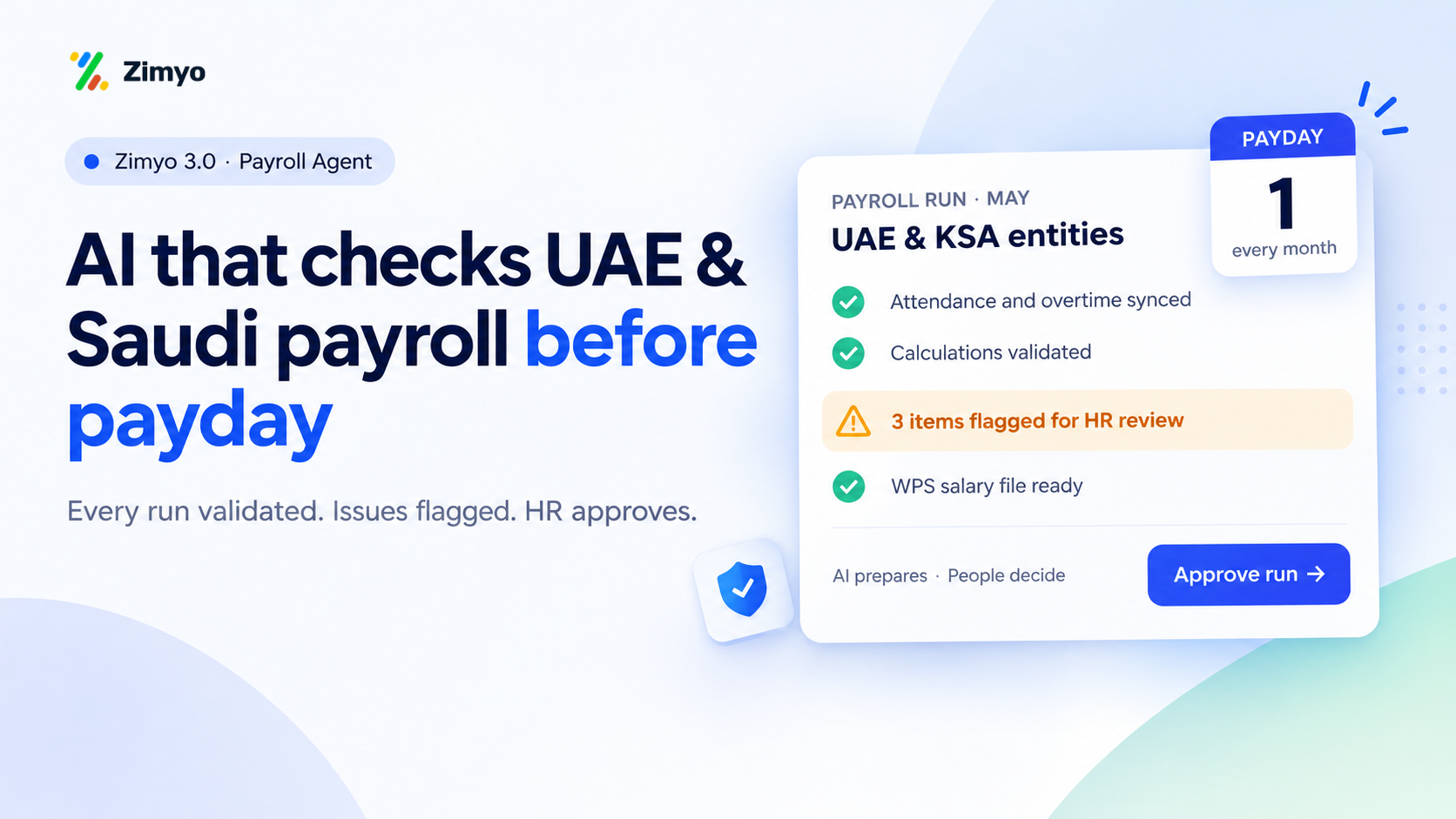
Since 1 June 2026, UAE private-sector salaries are due on the 1st of every month, and MOHRE starts sending warnings from the 2nd. A payroll error found after the salary file goes to the bank no longer has two weeks to be fixed quietly. In Saudi Arabia, a single payroll can now carry three GOSI contribution rates, depending on each employee's nationality and GOSI registration date.
The Zimyo Payroll Agent, part of Zimyo 3.0, is built for that gap. It validates each payroll run, flags issues for review and answers employees' pay questions, while HR and finance keep the final approval.
This guide covers what the agent does, where it fits in UAE and Saudi payroll, and what to check before you trust any AI with salaries.
What is the Zimyo Payroll Agent?
The Zimyo Payroll Agent is an AI agent in Zimyo 3.0 that works on top of Zimyo's payroll module. It automates calculations and validations, flags issues in a payroll run before approval, schedules runs and answers employees' payroll questions. Every AI action is logged, and critical decisions need human approval.
It is one of the ZIM Agents that power Zimyo 3.0, alongside agents for the HR helpdesk and employee onboarding. Zimyo describes the principle behind all of them in four words: AI prepares, people decide.
The agent does not replace your payroll engine. For Middle East customers, Zimyo payroll already generates WPS-compliant salary files and automates gratuity calculations. It runs payroll for the UAE, Saudi Arabia, Qatar, Oman, Kuwait, Bahrain and Egypt from one platform, with GOSI support and an Arabic interface for Saudi teams. The agent works on that data, so problems surface before money moves.
Why UAE and Saudi Payroll Now Needs a Check Before The Run
Two 2026 changes have made payroll mistakes in the GCC harder to absorb.
UAE: The 1st of the month is now payday for everyone
MOHRE's Ministerial Resolution No. 340 of 2026, issued on 12 May, made the first day of each Gregorian month the due date for the previous month's wages from 1 June 2026. It applies to MOHRE-registered private-sector employers, replaces contract-based pay dates and removes the old 15-day grace period. Enforcement now runs on a fixed clock:
| Day of the month | What happens if salaries are unpaid |
|---|---|
| 1 | Previous month's wages due through WPS or another MOHRE-approved channel |
| 2 | MOHRE starts sending warnings to the employer |
| 5 | New work permits are suspended |
| 11 | Administrative fines apply; repeat offenders within six months can be downgraded to MOHRE's third category |
| 16 | MOHRE can register a labour dispute on employees' behalf |
| 21 | Serious or repeat cases can be referred to the Public Prosecution, with possible travel bans |
There is a second rule payroll teams often miss. A payment only counts as made if each employee receives at least 85% of their total wages, with the rest covered by lawful deductions. An incorrect deduction can therefore leave an employee recorded as unpaid, even when the transfer went through on time.
Saudi Arabia: Three GOSI treatments in one payroll
Saudi salaries move through the Wage Protection System, with Mudad handling file submission. GOSI is where the calculation risk sits:
- Saudi nationals first registered with GOSI before 3 July 2024 stay on the legacy combined rate of 21.5%.
- Saudi nationals registered on or after 3 July 2024 fall under the new Social Insurance Law. Their combined rate rose to 23.5% on 1 July 2026 and keeps climbing by 0.5% each for employer and employee every July until 2028.
- Expatriates carry only the employer's 2% occupational hazards contribution.
The rate follows the GOSI registration date, not the hire date. A Saudi employee first registered with GOSI at a previous job before July 2024 stays on the legacy rate, even if they joined you last month.
These are exactly the checks that slip when one person reviews hundreds of payslips on the last working day of the month.
What The Payroll Agent Does Across The Payroll Cycle
The agent's main job is to move review earlier: issues are flagged for HR to clear before approval, not discovered after an employee calls. Here is where it works in a typical UAE or Saudi cycle.
| Stage | What the Payroll Agent does | Why it matters in the UAE and KSA |
|---|---|---|
| Before the run | Automates calculations and validations; flags issues in the run for review | Errors are fixed before the WPS salary file is generated, inside a calendar with no grace period |
| Scheduling | Schedules payroll runs automatically | In the UAE, runs can be planned back from the fixed 1st-of-month deadline |
| Approval | Simplifies approvals and documentation; logs every AI action | HR and finance approve with flagged items and reasons in front of them, and keep a record for audits |
| After payday | Answers employees' payroll and policy questions; gives quick payslip access | Fewer "why is my salary different?" tickets in the days after payday, when HR is also tracking WPS confirmations |
| Planning | Produces AI payroll reports, compensation trend insights and payroll cost forecasts | Finance sees cost trends ahead of changes such as the annual GOSI step-up for new Saudi registrants |
Because the agent sits on Zimyo's payroll data, it works with what that module already holds: attendance and overtime, salary structures, gratuity accruals, WPS files and, for Saudi teams, GOSI contributions.
Payroll Agent vs Standard Payroll Automation
Most GCC payroll tools already automate the calculation. The difference with an agent is the work around it: checking, explaining and answering.
| Standard payroll automation | Zimyo Payroll Agent | |
|---|---|---|
| Core job | Calculates pay from rules you configure | Works on the calculated run: validates, flags and explains |
| When errors surface | Often after payout, through employee complaints or rejected transfers | Before approval, as flagged items for HR |
| Employee pay questions | Raised as tickets for HR to answer | Answered by the agent, with payslip access |
| Reporting | Standard payroll reports | AI-generated reports, trend insights and cost forecasts |
| Final decision | HR and finance | Still HR and finance; the agent prepares, people approve |
AI Prepares, People Decide: Where HR Stays in Control
The Payroll Agent does not release salaries on its own judgement. AI actions are logged, and critical decisions such as approving a payroll run need a person to sign off.
That matters more in the GCC than almost anywhere else. Once a WPS file is processed, the payment record sits with the bank and the regulator, and correcting it afterwards takes far longer than fixing it before. A logged trail of what the agent flagged, and who approved what, also gives HR a clear record if MOHRE or an employee questions a payment later.
Zimyo designed ZIM to read an organisation's own policies before acting, so it works from your rules rather than a generic template. The platform holds ISO 27001 certification and follows GDPR practices.
How to Evaluate An AI Payroll Agent For The GCC
Many payroll tools now carry an "AI" label. Use these questions in a demo to separate a working agent from a chatbot added to old software.
- Is local compliance built into the payroll underneath? Ask to see a WPS salary file for the UAE and a GOSI calculation for a Saudi employee registered on or after 3 July 2024.
- Does it check before approval or report after payout? Flags raised after salaries are paid do not help with a 1st-of-month deadline.
- Does every flag explain itself? HR should see why an item was flagged without opening a spreadsheet.
- Can anything be paid without human approval? The answer should be no.
- Can employees use it in Arabic? Self-service only cuts tickets if staff can use it comfortably.
- Does one platform cover all your GCC entities? Running the UAE and Saudi Arabia on separate tools doubles the review work.
- Where is payroll data hosted, and what certifications cover it? Get the answer in writing.
- Are AI agents included in the plan or priced separately? Clarify this before comparing quotes.
Zimyo handles WPS files, GOSI, gratuity and multi-country GCC payroll on one platform with an Arabic interface, and its agent needs human approval for critical decisions. Use the demo to see the agent's flags on a sample of your own payroll, and to confirm hosting and plan details.
Payroll That Is Checked Before It Leaves
The UAE has removed the slack from payroll, and Saudi Arabia's GOSI changes add a new calculation risk every July until 2028. The useful question is no longer whether payroll is automated, but whether anything checks it before money moves.
That is the Zimyo Payroll Agent's job: prepare the run, flag what looks wrong, answer the questions that follow, and leave the decision with your team.
Frequently Asked Questions
What is the new salary payment date in the UAE?
From 1 June 2026, private-sector salaries for the previous month are due on the first day of each Gregorian month under MOHRE Ministerial Resolution No. 340 of 2026. The old 15-day grace period no longer applies.
How is GOSI calculated for Saudi employees in 2026?
It depends on the GOSI registration date. Saudis registered on or after 3 July 2024 carry a combined employer-plus-employee rate of 23.5% from 1 July 2026; those registered earlier stay at 21.5%. Expatriates carry only the employer's 2% occupational hazards contribution.
Does Zimyo generate WPS salary files?
Yes. Zimyo payroll generates WPS-compliant salary information files for UAE employers and supports WPS and GOSI for Saudi employers.
Which Middle East countries does Zimyo payroll cover?
The UAE, Saudi Arabia, Qatar, Oman, Kuwait, Bahrain and Egypt, all from one platform.
Can the Payroll Agent answer employees' salary questions?
Yes. It answers payroll and policy questions and gives employees quick access to their payslips, which reduces tickets after payday.
Will the Payroll Agent replace our payroll team?
No. It validates runs and flags issues, but approvals stay with HR and finance.