

Typical evaluations of ATS tend to analyze UAE-based hiring processes the same way as they do any other. However, that isn't true.
A UAE national employed by your organization without adding the position into the Nafis system will not contribute to your Emiratisation percentage, even though you paid him the money and managed payroll. An incorrect job title that does not match an MoHRE classification code is the most common reason for denial of a work permit. A candidate who starts employment at your DIFC entity requires a DIFC-type contract, not an MoHRE one.
Not a single one of those aspects is an actual feature of an ATS. All of them define whether your hiring process stands up to scrutiny.
Here, we compare nine applicant tracking systems used by UAE companies based on how they help to comply with hiring practices in the UAE.
What UAE Hiring Requires That An ATS Has to Accommodate?
The sequence, and where it breaks
The recruitment process within the UAE follows a rigid process as set out by the government, namely job classification, MoHRE offer letter, work permit, entry, contract registration, residency. Each stage is contingent on the preceding stage, and the information must be consistent throughout.
Two failure points recur:
Job title mismatch. The job description must have a classification code, which must be approved by the MoHRE. If the position stated in the letter of offer does not coincide with the MoHRE category, then the work permit application gets rejected, and the process begins from scratch again. Such an ATS system gives rise to failure at the requisition phase itself.
Jurisdiction mismatch. Contractors on the mainland utilize the MOHRE contracts. The vast majority of free zones adopt the federal system but process through their own authority. DIFC and ADGM operate their independent common law systems that have their own contracts. When you operate in multiple jurisdictions, it is important for the ATS to understand whose requisition it is before sending out an offer.
Emiratisation changes what "hired" means
For organisations registered with MoHRE having 50 or more employees, 10% Emiratis have to be employed in skilled jobs by 31 December 2026, with a 2% increase per year, over two six-month periods. Failure to meet the requirement entails a monetary contribution per unfilled position per month.
What is relevant to ATS selection is more specific than what most guides state. An employee recruited without posting the vacancy on Nafis is not considered in your requirement despite paying their salary and payroll; hence, you may be under-quota despite all that. The key question therefore is not about posting your ATS vacancies on job sites but whether your Emirati vacancies have been posted on Nafis and if the system can produce the report on your skilled position's nationality breakdown.
Small enterprises are not exempt from the requirement: organisations with between 20 to 49 employees in 14 designated sectors have headcount targets set for them rather than percentage requirements.
Language and documentation
Contracts need to be written in Arabic, with English also possible to attach. The employment contracts are fixed-term in nature; unlimited contracts are no longer offered via MoHRE. Certificate attestation takes time for foreign applicants, and the ATS, which shows document completion status vis-à-vis the start date, does some real work.
Verify before you rely on this. Emiratisation targets and contribution rates have changed repeatedly, and sector-specific targets apply in banking, insurance, and other regulated industries. Confirm your position with MoHRE or your employment counsel.
How We Evaluated These Platforms?
We assessed each system against four criteria, applied consistently:
- UAE recruiting process compatibility - is it aligned with MoHRE employment classification, jurisdiction-based requisitioning, and document management against attestation timelines?
- UAE sourcing breadth - is it linked up with the job boards used by UAE candidates, and can Emirati job postings be sent to Nafis?
- Hand-off to HR - will the hired candidate turn into an employee, or will data have to be entered all over again?
- Compatibility by company type - is it really suited for the scale it claims to be good at?
On pricing and ratings: most ATS platforms serving the UAE quote rather than publish. Where a public price or a verified third-party rating exists, it appears below. Where it doesn't, we say so rather than estimating.
Top ATS Platforms in UAE: Comparison Table
| Platform | Best suited to | Published pricing | Rating | Standout |
|---|---|---|---|---|
| Zimyo ATS | 25–500 employees, UAE + GCC | AED 10 / 20 / 30 per user per month | G2 4.5 | ATS Standalone or inside the HRMS; ISO 27001 certified |
| GoHire | Small teams, first ATS | Published tiers, confirm current rates | No verified score | Low-cost entry with multi-board posting |
| Workable | 50–500 employees, high volume | Published tiers | No verified score | 200+ job board reach, AI matching |
| Talentra | UAE recruitment agencies | Quote only | No verified score | ATS and client CRM in one |
| Xobin Tracks | High-volume screening | Quote only | No verified score | AI-native, assessments built in |
| Recruitee | 20–200 employees, collaborative hiring | Published tiers | No verified score | Team-based evaluation workflows |
| Ceipal | Enterprise and staffing firms | Quote only | No verified score | Enterprise scale and analytics |
| Breezy HR | SMEs wanting visual pipelines | Free tier available | G2 4.4, Capterra 4.5 | Drag-and-drop Kanban pipeline |
| Zoho Recruit | Budget-conscious, Zoho users | From ~AED 110 (USD 30) per recruiter per month | G2 4.4 | Lowest cost with a large review base |
Note on ratings: six platforms here have no aggregate third-party score we could verify. That reflects how narrow the ATS review market is in this region, not product quality, but it does mean reference calls matter more than usual for those six.
Best ATS Software in UAE: In Detail
1. Zimyo ATS
Zimyo ATS runs standalone or inside the wider HRMS, is ISO 27001 certified with full tenancy isolation, and is the only platform here publishing its pricing in dirhams.
Core recruitment covers one-click posting to multiple boards, resume parsing, custom career pages, requisition management with approval workflows, candidate scorecards, stage-based reviews, and filtering across internal and external talent pools.
What changes the economics is the option. Bought standalone, it competes on the recruitment feature set alone. Bought alongside the HRMS, a hire stops being an export; the candidate record becomes an employee record with WPS-ready payroll and gratuity accrual already attached, and nobody re-keys a name, an Emirates ID, or a salary figure into a second system. Most teams discover that cost only after their first month of parallel data entry.
On security: ISO 27001 certified, with AES-256 encryption at rest, TLS 1.3 in transit, role-based access control, audit logging, two-factor authentication, and complete tenancy isolation. SOC 2 Type 2 certification is in progress. Support runs in UAE hours from a Dubai team, worth weighing if your hiring cycle can't absorb an overnight wait on a blocked requisition.
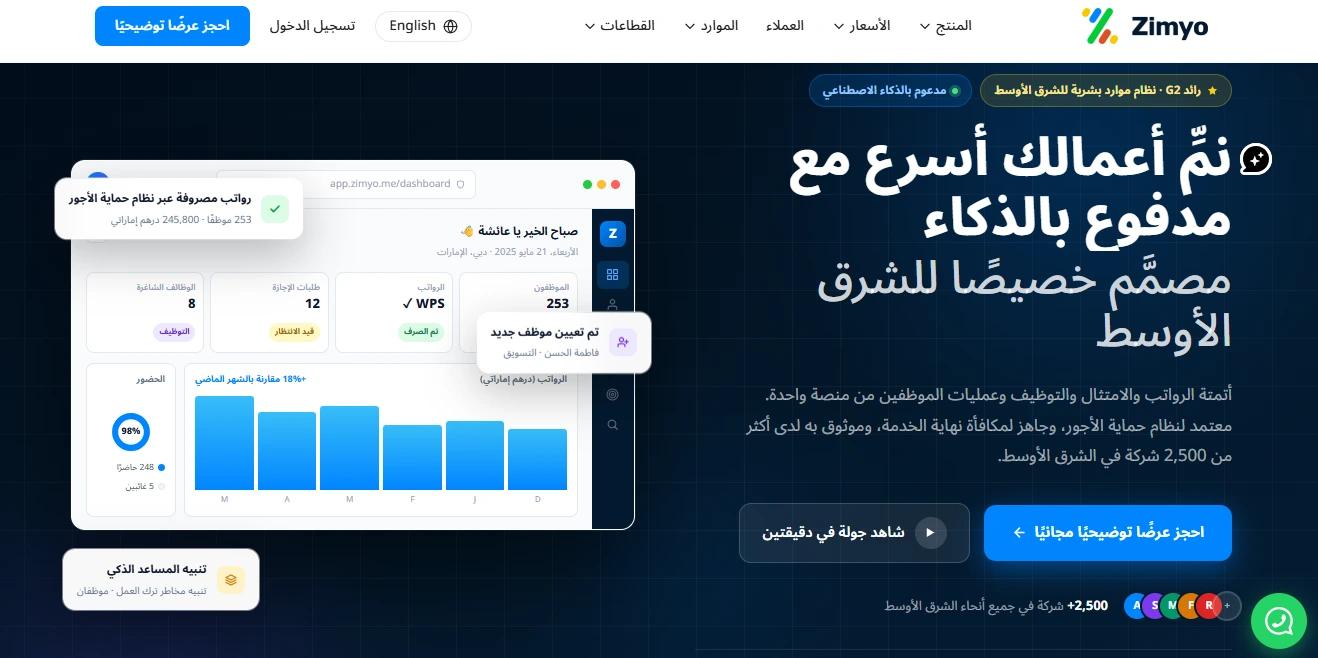
Pricing: The standalone ATS is AED 149 per recruiter per month, priced per recruiter, so cost scales with your hiring team rather than your headcount. The full HRMS, with recruitment included, runs AED 10, 20, and 30 per user per month across three plans with a 25-user minimum.
Rating: 4.5 on G2.
| Pros | Cons |
|---|---|
| ISO 27001 certified with encryption at rest and in transit, audit logging and full tenancy isolation | SOC 2 Type 2 is in progress rather than certified |
| Available standalone or with the HRMS, where a hire becomes an employee record without re-entry | The 25-user minimum on published plans rules out the smallest teams |
| Published AED pricing, making it possible to budget before a sales call | Per-recruiter pricing gets expensive if many hiring managers need full access rather than view-only |
| One system across seven Middle East markets, with UAE-hours support from Dubai | Smaller independent review base than the global ATS specialists here |
Best for: 25–500 employees wanting recruitment and HR on one platform rather than two.
2. GoHire
GoHire is an entry-level ATS built for small teams making their first move off spreadsheets and email, with published pricing and quick setup.
It covers the essentials: customisable recruitment workflows, automated resume screening and interview scheduling, multi-board posting, and reporting on pipeline progress. It integrates with existing HR tools.
Pricing: Published tiers. Confirm current rates directly; pricing in this segment changes often.
Rating: No aggregate third-party score verified.
| Pros | Cons |
|---|---|
| Published pricing at the low end of the market | No UAE-specific compliance features |
| Fast to set up with minimal configuration | Limited depth for high-volume hiring |
| Multi-board posting from a single interface | Thin third-party review evidence |
| Workflow customisation without technical resource | No Nafis or MoHRE classification support |
Best for: Teams under 50 hiring occasionally, moving off manual processes.
3. Workable
Workable's strength is reach: over 200 job boards and social channels from one posting action, plus AI-assisted candidate matching.
Used globally and widely recognised in this category, Workable combines sourcing breadth with structured evaluation: interview scorecards, collaborative decision tools, and a mobile app for hiring managers. AI matching surfaces candidates against job requirements rather than keyword matches alone.
Pricing: Published tiers, with per-job and per-user models depending on plan. Confirm current rates directly.
Rating: No aggregate third-party score verified.
| Pros | Cons |
|---|---|
| The widest job board network of any platform here | No UAE-specific compliance layer |
| AI candidate matching against role requirements | Costs climb quickly with hiring volume |
| Structured scorecards reduce evaluation variance | Not an HRMS, handoff to HR needs integration |
| Strong mobile experience for hiring managers | Regional support runs outside GCC hours |
Best for: 50–500 employees hiring at volume where sourcing reach is the constraint.
4. Talentra
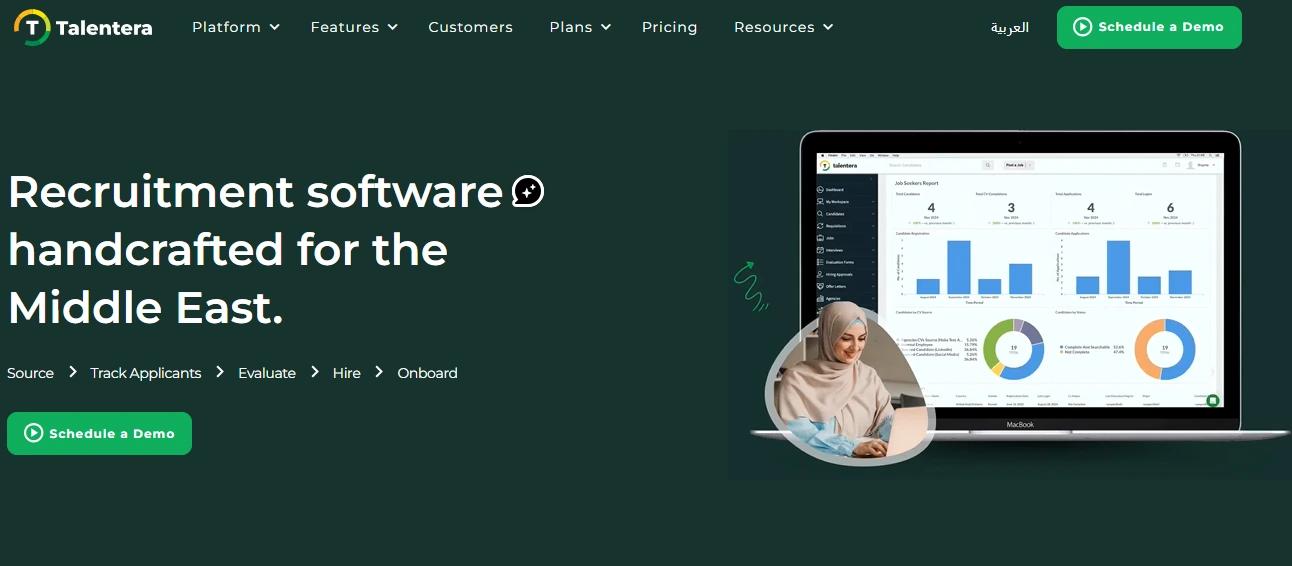
Talentra was designed specifically for recruitment companies in the UAE, integrating all functionalities of candidate tracking and client relationship management into one suite.
The distinction matters. Agencies run two pipelines, candidates and clients, and most ATS platforms only handle the first. Talentra's CRM tracks client relationships, sales pipelines, and business development alongside candidate sourcing and placement, which aligns recruitment performance with client expectations in the same view.
Pricing: Quote only.
Rating: No aggregate third-party score verified. Public product documentation is thinner than for any other platform here, so treat vendor claims as needing more verification than usual and ask for reference customers of comparable size.
| Pros | Cons |
|---|---|
| ATS and client CRM in a single system | Built for agencies, over-specified for in-house teams |
| Placement analytics tied to client accounts | No published pricing |
| Real-time collaboration for recruitment teams | Limited public product documentation |
| Job board and social sourcing integrations | Thin independent review evidence |
Best for: UAE recruitment and staffing agencies running high placement volume.
5. Xobin Tracks
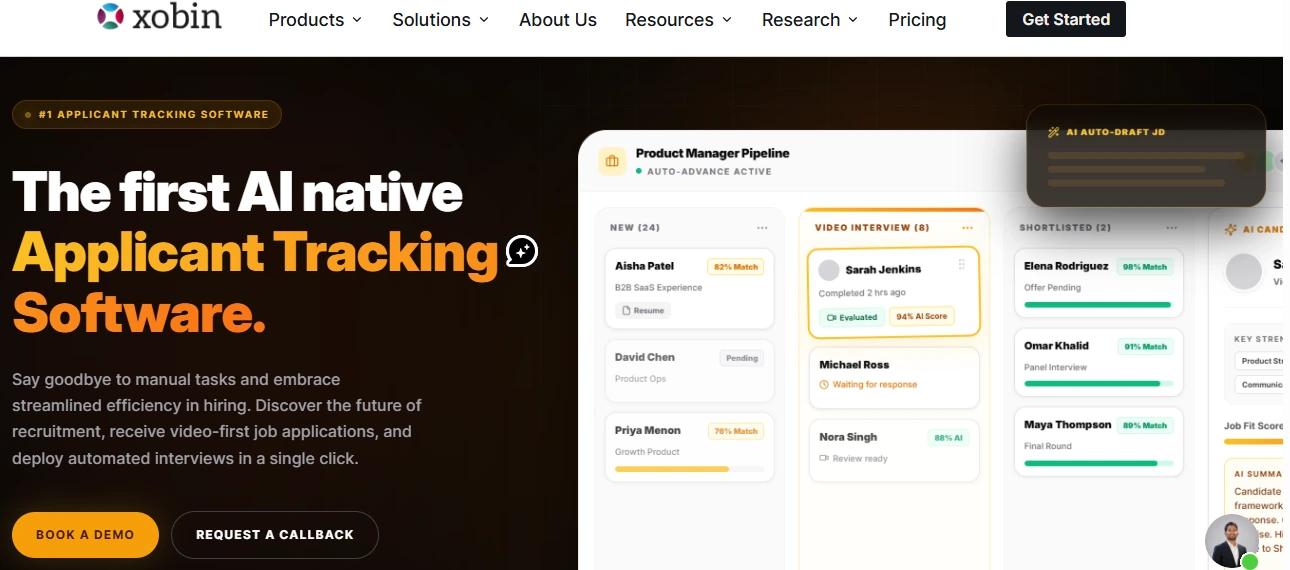
Xobin Tracks is an assessment-led ATS; screening and interviewing are built into the pipeline rather than bolted on, which suits high applicant volume and over-serves everyone else.
The design assumption is that your bottleneck is screening, not tracking. Candidates auto-advance between stages against defined criteria, video interviews run without an interviewer present, and AI fitment scores drive one-click shortlisting. Job descriptions are generated from a prompt. If you are filling three roles a quarter, most of this sits unused; if you are working through four hundred applications for one opening, it is the difference between a week and an afternoon.
Pricing: Quote only.
Rating: No aggregate third-party score verified.
| Pros | Cons |
|---|---|
| Assessment and interviewing built in, not integrated | Assessment-led design is heavier than teams hiring occasionally need |
| Middle East data centres, the only regional residency here | No published pricing |
| Auto-advance and AI shortlisting cut screening time | Limited independent review evidence to date |
Best for: UAE organisations screening high candidate volume where assessment quality, not pipeline visibility, is the bottleneck.
6. Recruitee
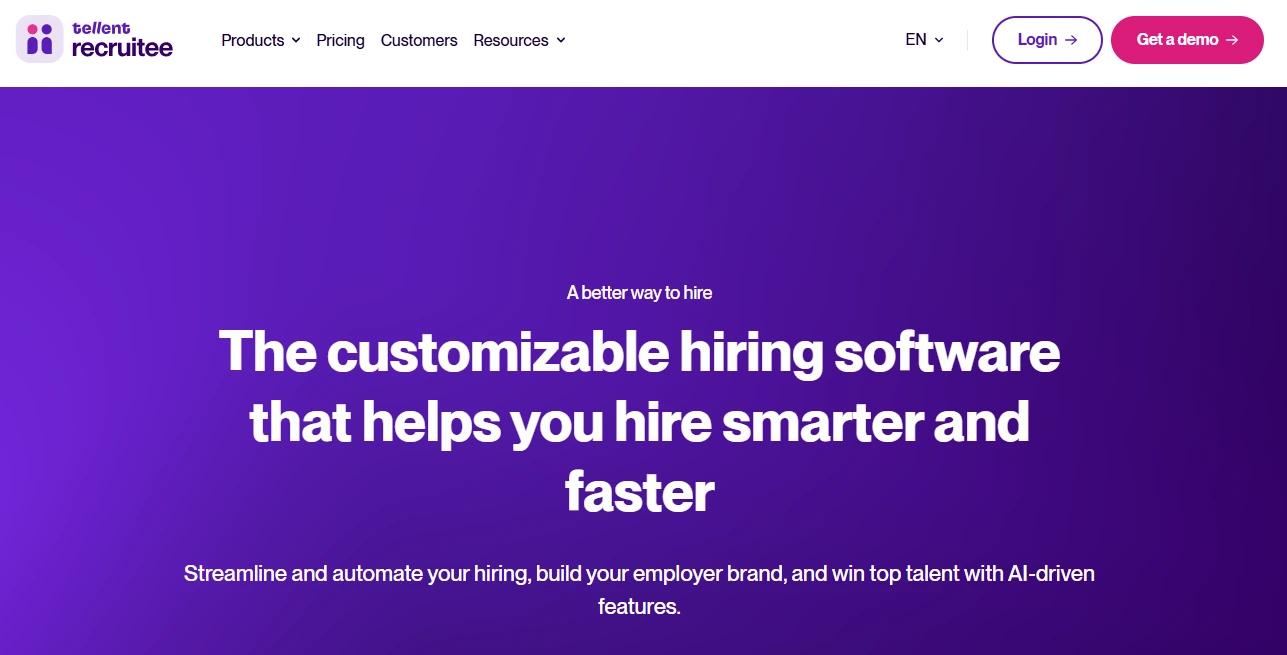
Recruitee is built around collaborative hiring, the assumption that hiring managers, not just recruiters, make the decisions.
The platform keeps job posting, candidate tracking, and team evaluation in one place with a deliberately simple interface. Hiring pipelines and workflows customise to each company's process, and automated email and SMS keep candidates informed without manual follow-up.
Pricing: Published tiers.
Rating: No aggregate third-party score verified.
| Pros | Cons |
|---|---|
| Strong team evaluation and collaboration tools | No UAE compliance features |
| Simple enough for hiring managers to use unaided | Lighter analytics than enterprise platforms |
| Customisable pipelines without technical setup | Not an HRMS |
| Automated candidate communication built in | Limited independent review evidence |
Best for: 20–200 employees where hiring managers are heavily involved in decisions.
7. Ceipal
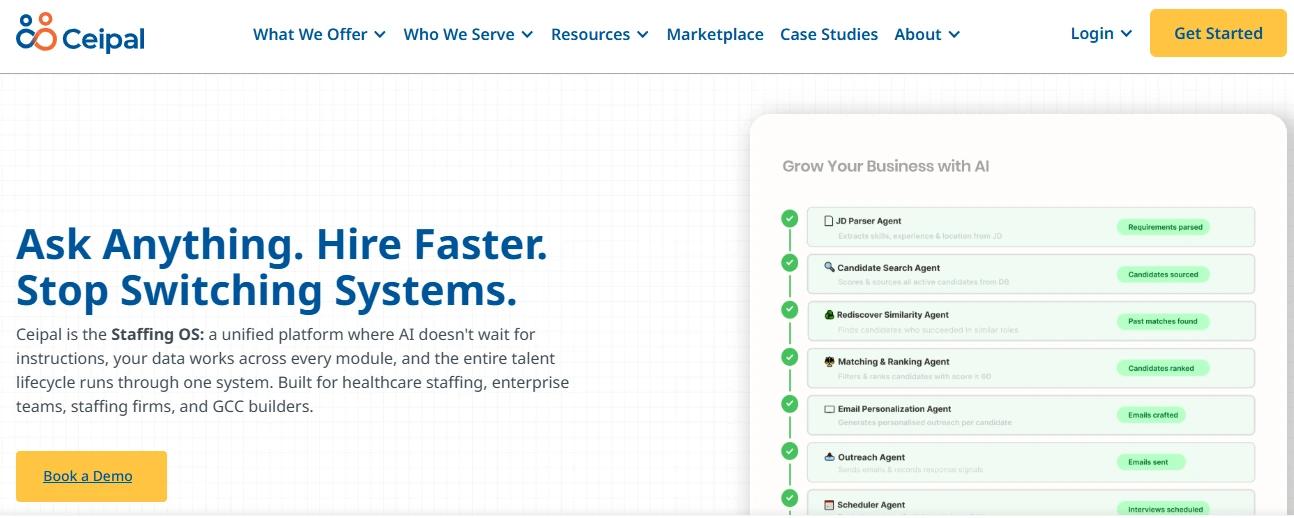
Ceipal is an enterprise-level recruiting software with advanced analytics, designed for companies and recruitment agencies engaged in complicated recruitment processes.
It covers candidate sourcing through to post-hire HR functions, with customisable workflows, dashboards and reporting depth that mid-market tools don't attempt. Integration with wider HR modules makes it viable as part of a larger stack.
Pricing: Quote only.
Rating: No aggregate third-party score verified.
| Pros | Cons |
|---|---|
| Enterprise analytics and reporting depth | Substantial overkill below 200 employees |
| Highly customisable workflows and dashboards | No published pricing |
| Scales to very high hiring volume | UAE-specific depth needs verifying in a demo |
| Integrates with broader HR systems | Implementation requires structured project resource |
Best for: Large UAE enterprises and staffing firms where analytics and scale are the requirement.
8. Breezy HR
Breezy HR is the most approachable platform here, a drag-and-drop Kanban pipeline that hiring managers pick up without training, with a genuinely free tier.
Founded in 2014 and owned by Learning Technologies Group since 2019, Breezy is used by over 10,000 companies across 72 countries. It covers job posting to 50+ boards, built-in video interviews, automated messaging and scheduling, branded career pages, and reporting against hiring KPIs. Scorecards and interview feedback stay attached to candidate stage history, which makes the evaluation trail auditable.
Pricing: Free tier for one active position; paid plans scale from there.
Rating: 4.4 on G2, 4.5 on Capterra.
| Pros | Cons |
|---|---|
| Free tier makes it genuinely testable before committing | Feature availability is heavily plan-gated |
| The most intuitive interface in this comparison | No UAE compliance features |
| Verified ratings across two review platforms | Not an HRMS |
| Audit-ready evaluation trail via stage-linked scorecards | Reporting is basic against enterprise tools |
Best for: SMEs where hiring manager adoption is the biggest risk.
9. Zoho Recruit
Zoho Recruit is the budget option with a serious review base, published per-recruiter pricing and native integration into the wider Zoho suite.
It handles sourcing, candidate management, customisable hiring pipelines and resume parsing, with an agency mode for staffing firms alongside the corporate version. If you already run Zoho People, Zoho Books or Zoho Payroll, the candidate-to-employee handoff works without integration work.
Pricing: Published, from approximately AED 110 (USD 30) per recruiter per month.
Rating: 4.4 on G2.
| Pros | Cons |
|---|---|
| Lowest published cost of any full ATS here | No UAE-specific compliance features |
| Large verified review base | Value drops sharply outside the Zoho ecosystem |
| Both corporate and staffing-agency modes | Interface feels dated against newer platforms |
| Native handoff if you run other Zoho products | Support response times are a recurring complaint |
Best for: Cost-sensitive teams, and any size of business already running Zoho.
Choosing By Situation
Hiring occasionally, under 50 employees. HR Breeze's Free Tier or Zoho Recruit for about AED 110 per recruiter. Zimyo's standalone ATS for AED 149 should be considered if you require UAE-hours support and ISO 27001 compliance. Note that the 25-user minimum applies to the HRMS only.
25–500 employees who want recruitment and HR together. Zimyo, particularly if you also operate in Saudi, Qatar, or elsewhere in the GCC.
High-volume hiring where screening is the bottleneck. Xobin Tracks for assessment depth; Workable for sourcing reach. Different problems.
Recruitment or staffing agency. Talentra for the client CRM; Ceipal at enterprise scale.
Emiratisation-critical hiring. No platform here integrates with Nafis directly. Register vacancies on Nafis separately and treat your ATS as the pipeline tool, not the compliance record. If a vendor claims Nafis integration, ask to see it in the demo.
Six Questions to Ask Every ATS Vendor
- Can requisitions carry a MoHRE job classification code? Title mismatches are the leading cause of permit rejection.
- Can the system distinguish entities by jurisdiction? Mainland, free zone, DIFC, and ADGM need different contract templates.
- Can it report skilled-role headcount by nationality? That's your Emiratisation position, and you need it monthly, not annually.
- Does it track document attestation status against start dates? International hires stall here.
- What happens at "hired"? A CSV export means someone has to re-key everything into your HR system.
- Where is candidate data stored? Ask specifically about regional data centers if procurement requires it.
In Conclusion
The checkboxes do not differentiate between these nine because they all handle job postings, resume parsing, and going through various stages. What will differentiate them for a UAE firm is the treatment of these edges, whether the requisition knows its entity and jurisdiction, whether the new hire is really an employee and not just a row in a spreadsheet, and whether you can answer your Emiratisation question without having to investigate three systems.
Run a demo with an actual requisition, a tough job to fill in an entity which you really own, and a candidate needing attestation.
Frequently Asked Questions
What is the best ATS in UAE?
This varies depending on your objective. Use Zimyo for any need of recruiting and HR in one package overseeing UAE compliance. Xobin Tracks could be a fit if screening capacity alone is an issue. Use Breezy HR or Zoho Recruit if cost is the major factor.
How much does an ATS cost in the UAE?
The pricing for the standalone ATS is AED 149 per recruiter per month by Zimyo, whereas the pricing for the whole HRMS, including the recruitment module, is AED 10-30 per user per month. Zoho Recruit is priced at around AED 110 (USD 30) per recruiter, and Breezy HR has a free plan.
Does an ATS handle Emiratisation compliance?
None of the platforms mentioned can connect to Nafis. You need to register your Emirati positions through Nafis directly. If you hire an Emirati outside of the above process, then he might not be considered under your quota.
Does an ATS integrate with HR software in the UAE?
Most integrate through API and exporting. The one that does not do this is an ATS embedded in an HRMS, whereby the candidate becomes an employee without any transfer stage. This aspect is important, especially for recruiting in bulk.