


Choosing HR software in Egypt has become a harder decision than it was two years ago. Labour Law No. 14 of 2025 replaced a framework that had stood since 2003. Income tax brackets were rewritten. Social insurance wage limits now step up every January. Any evaluation that ignores those three facts is measuring the wrong things.
This guide compares eight platforms that genuinely operate in Egypt, with published pricing where it exists and honest trade-offs for each.
What Changed: The Compliance Baseline for 2026
Before comparing vendors, it's worth being precise about what an HR system in Egypt has to get right.
Labour Law No. 14 of 2025 in brief
Egypt's new Labour Law took effect on 1 September 2025, replacing Labour Law No. 12 of 2003. The changes that matter for software selection are these:
- A statutory annual increment of at least 3% of the social insured salary — calculated on insured salary, not gross.
- Maternity leave extended from 90 to 120 calendar days, with at least 45 days after delivery.
- Paternity leave introduced for the first time.
- New workforce reporting to the Ministry of Manpower covering headcount, qualifications, professions, age groups, nationalities, gender and salaries.
Practically, this means your system needs configurable leave policies rather than hardcoded ones, an increment workflow tied to insured salary, and reporting that can produce a workforce breakdown on demand.
For the full detail on the new law, including contract requirements and the specialised labour courts, see our complete guide to Egyptian labour law.
Payroll: Three Separate Deductions
Egyptian net pay is gross salary minus three distinct employee-side items, each governed by different legislation:
- Social insurance under Social Insurance Law No. 148 of 2019, administered by NOSI. Employee contributes 11% of the insurable wage; employer contributes 18.75%.
- Salary income tax under Income Tax Law No. 91 of 2005, as amended by Law No. 7 of 2024. Seven progressive brackets from 0% to 27.5%, applied after an annual personal exemption of EGP 20,000. Employers withhold monthly under PAYE and file with the Egyptian Tax Authority.
- Martyrs and Victims Fund contribution, a small separate levy that generic payroll tools frequently omit.
Two details trip up international software repeatedly:
- Insurable wage limits reset every January. The monthly insurable salary band moved to EGP 2,700–16,700 with effect from January 2026. A system calibrated on last year's ceiling silently produces wrong numbers for every employee above the old ceiling.
- Tax brackets are annual, not monthly. Systems that compute tax on a monthly basis push lower-paid employees into the wrong band. The calculation must annualise.
Verify before you rely on this. Egyptian insurable wage limits are adjusted annually and tax brackets have been amended twice in recent years. Confirm current figures with the Egyptian Tax Authority, NOSI, or your accountant before configuring payroll.
Arabic is not a nice-to-have
Egypt's workforce is Arabic-speaking. An English-only interface guarantees poor employee self-service adoption, and self-service is where most of the return on HR software is realised. What matters is genuine right-to-left support and bilingual document output — contracts, payslips, letters — rather than a translation layer over an English product.
A Note On The Pricing in Ihis Guide
Most vendors in this category quote rather than publish. Of the eight platforms here, only two maintain a public rate card, and only one publishes Egypt-specific pricing in Egyptian pounds. Where no published price exists, that's stated plainly rather than filled with an estimate.
When you request quotes, ask for them in EGP. Dollar-denominated pricing shifts your budget every time the exchange rate moves, and the pound has traded between roughly 46.6 and 54.9 to the dollar over the past year.
Best HR Software in Egypt: Comparison at a Glance
| Platform | Best suited to | Published pricing | Rating | Arabic / RTL |
|---|---|---|---|---|
| Zimyo | 25–500 employees, Egypt + GCC | EGP 150 / 200 / 300 per user per month | G2 4.5 | Bilingual documents, full RTL |
| ZenHR | 20–500 employees, Egypt-focused | No published rate card | G2 4.6 | Bilingual platform |
| Bluworks | SMEs with frontline teams | Publicly indicated, not a rate card | No third-party profile | Egyptian-built |
| Menaitech (MenaPAY) | Mid-market to enterprise | Three editions, quote-based; free trial | Listed, no aggregate rating | Arabic-first design |
| LoginHR | Egyptian mid-market and enterprise | No published rate card | No third-party profile | Arabic and English |
| HITS | Egyptian mid-market to enterprise | No published rate card | No third-party profile | Arabic and English |
| Mercans | 200+ employees, multinational | No published rate card | G2 4.8 | Supported |
| Odoo HR | Existing Odoo ERP users | Public pricing, free entry tier | G2 4.3 (Odoo ERP) | Community-dependent |
The Platforms in Detail
1. Zimyo
Zimyo is an all-in-one HR and payroll platform that processes payroll across seven Middle East markets - UAE, Saudi Arabia, Qatar, Kuwait, Bahrain, Oman and Egypt - from a single system, with bilingual Arabic and English document generation.
The case for Zimyo is strongest when Egypt isn't your only market. Running a Cairo office alongside entities in Dubai or Riyadh means reconciling separate systems every month; consolidating removes that work entirely. Coverage spans core HR, payroll, performance, recruitment, engagement, timesheets and learning on one employee record. Contracts, payslips, letters and offer documents generate in Arabic and English side by side with full right-to-left support.
Security and residency are handled with AES-256 encryption at rest, TLS 1.3 in transit, role-based access, audit logs, two-factor authentication and complete tenancy isolation, meeting Middle East data residency requirements.
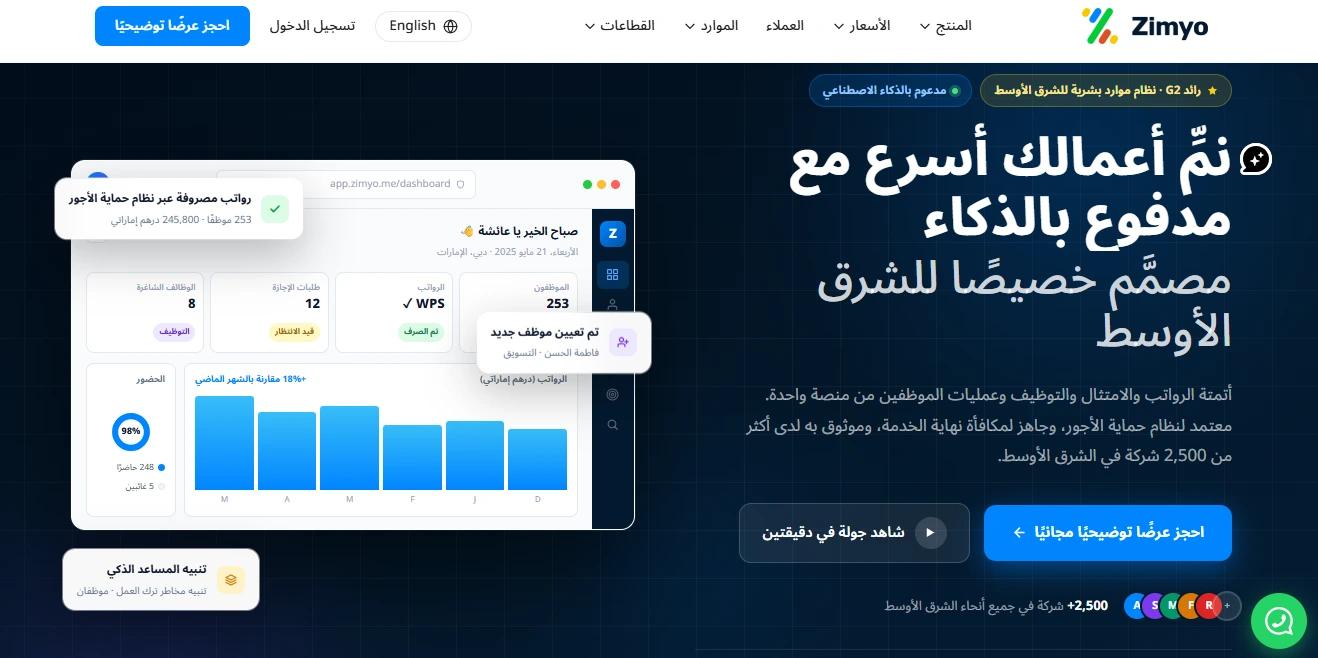
Pricing: Published on the Egypt pricing page in Egyptian pounds - Basic at EGP 150, Standard at EGP 200 and Enterprise at EGP 300 per user per month, billed monthly with a 25-user minimum. Optional add-on modules including Recruit, Learn, Timesheet and Digital Signature are priced separately. Enterprise supports multi-entity payroll across all Middle East countries plus Egypt.
Rating: 4.5 on G2.
Pros
- The only platform here publishing Egypt-specific pricing in EGP, so you can budget before a sales call
- A single system across seven Middle East countries removes month-end reconciliation between separate tools
- Bilingual Arabic and English document output with full RTL, not just a translated interface
- Modular add-ons mean you pay for recruitment or learning only if you use them
Cons
- A 25-user minimum means very small businesses will need to look elsewhere
- Built for multi-country Middle East operations, so an Egypt-only business is buying coverage it won't use
Best for: 25–500 employees, particularly operations spanning Egypt and the GCC.
2. ZenHR
ZenHR is a MENA-native HRMS with a dedicated Egypt product that handles income tax, Martyrs Tax, social insurance and end-of-service benefits in one bilingual system.
ZenHR is the most Egypt-specific of the regional platforms. It handles the three-part deduction structure natively, calculates gratuity by service years and contract type, and feeds lateness and overtime into payroll. Attendance runs through GPS, QR or biometric capture. The platform also operates across Saudi Arabia, UAE, Jordan, Iraq and Kuwait with country-specific compliance logic, and holds SOC 2 Type II certification.
Pricing: No published rate card. Third-party directories list it as custom-quoted.
Rating: 4.6 on G2.
Pros
- Names Egyptian statutory items explicitly as built-in features, including the Martyrs Tax that many platforms omit
- SOC 2 Type II certification, relevant for financial services and regulated sectors
- Three attendance capture methods: GPS, QR and biometric
- Established across five other MENA markets if you expand
Cons
- No published pricing, so budgeting requires a sales conversation
- Narrower functional footprint, light on learning management and advanced performance analytics
- Payroll-led design means less depth in talent and development modules
Best for: 20–500 employees, Egypt-focused or Egypt-plus-Levant operations where payroll compliance is the priority.
3. Bluworks
Bluworks is a Cairo-based platform built specifically for Egyptian frontline and blue-collar workforce management, covering shift scheduling, attendance, payroll processing and real-time salary disbursement.
Founded in 2022 by Hussein Wahdan and Farah Osman, Bluworks raised a seed round in November 2025 led by A15, Enza Capital and Beltone Venture Capital, following a pre-seed in April 2024.
Most HR software is designed for salaried office employees. Bluworks targets restaurants, retail, manufacturing and logistics, where scheduling is dynamic, attendance is geolocation-based, and many workers are unbanked or underbanked, which is why salary disbursement is built in rather than bolted on.
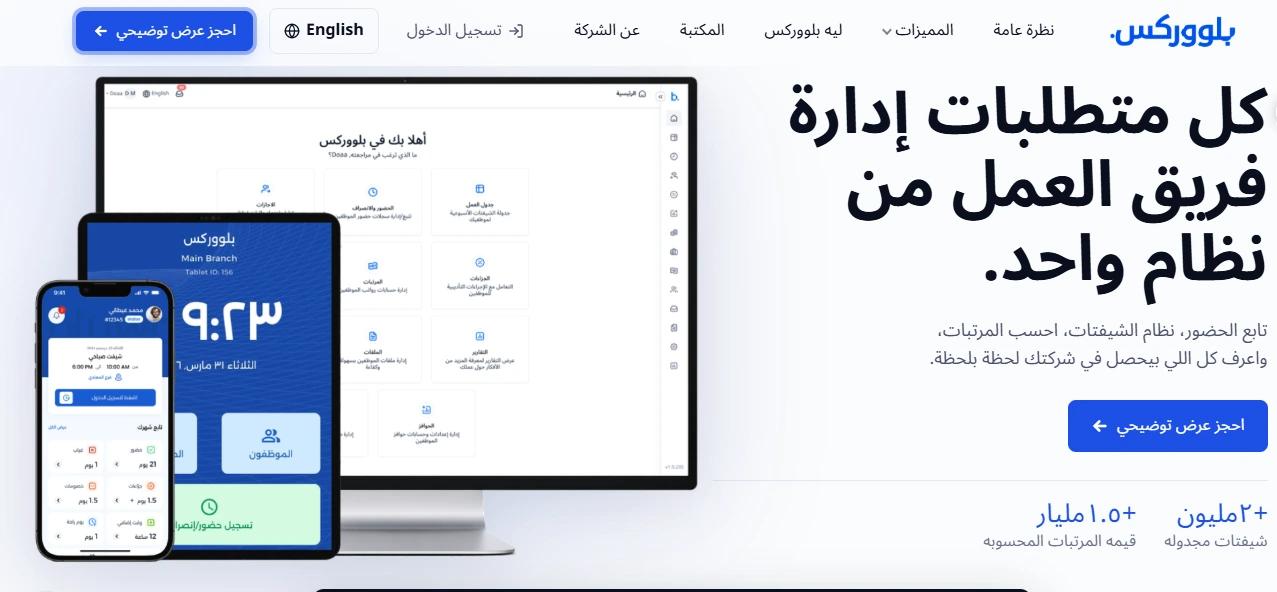
Pricing: Subscription plus a per-employee monthly fee, publicly indicated by the founders at roughly EGP 51–82 per employee per month depending on company size and plan. This is a stated figure rather than a published rate card, so confirm directly.
Rating: No third-party review profile.
Pros
- Built for Egyptian regulations from the ground up rather than adapted from international software
- The only platform here designed for shift-based and unbanked workforces
- Geolocation attendance and real-time disbursement address problems the others don't tackle
- Founders have discussed pricing publicly, which is unusual in this category
Cons
- Wrong fit for white-collar or salaried workforces
- Egypt-only, so regional expansion means adding a second system
- Founded in 2022, so it has a shorter operating history than the established vendors here
- No independent review profile to validate vendor claims against
Best for: Egyptian SMEs with hourly, shift-based or frontline workforces.
4. Menaitech (MenaPAY)
Menaitech has developed HR and payroll systems for the MENA region since the early 2000s and is one of the few platforms designed Arabic-first rather than translated into Arabic.
The product set spans MenaPAY for payroll and personnel and Curio for talent management, covering core HR, recruitment, time and attendance, performance, succession planning and self-service. It is available cloud-based or on-premise, which matters for organisations with data residency requirements or restricted network environments. Menaitech holds ISO 27001 certification with role-based access control and encryption in transit and at rest, and maintains a dedicated Egypt operation.
Pricing: Three editions, all quote-based, with a free trial available.
Rating: Listed on G2 and Gartner Peer Insights; no aggregate star rating published.
Pros
- Arabic-first architecture rather than an Arabic layer over an English product
- Two decades of MENA regulatory experience across multiple countries
- Cloud or on-premise deployment to suit data residency requirements
- A certification academy means trained administrators exist in the regional job market, which helps when your HR systems person moves on
Cons
- No published pricing and no aggregate third-party rating to benchmark against
- On-premise deployment carries infrastructure cost and internal IT requirements
- Breadth across many countries means Egypt-specific depth needs verifying in a demo
- Published customer counts vary between sources, so ask for a current Egypt figure
Best for: Mid-market and enterprise organisations operating across multiple Arabic-speaking markets.
5. LoginHR
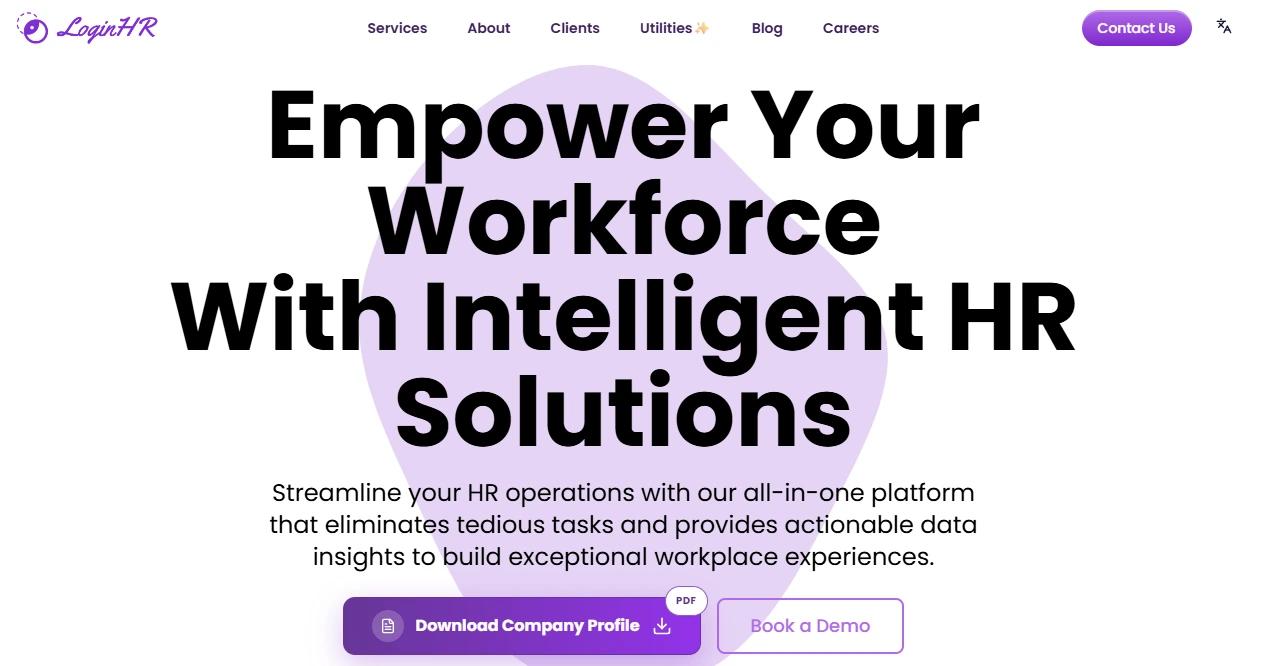
LoginHR, developed by Cairo-based LOGIN SYSTEMS, is an Egyptian HRMS specialist with more than eight years of continuous development focused solely on the local market.
LoginHR offers cloud-based HR management with payroll, attendance tracking, an employee self-service mobile application and performance analytics. Its client base skews toward Egyptian industrial and joint-stock enterprises, including organisations connected to the Ministry of Military Production.
Pricing: No published rate card.
Rating: No third-party review profile.
Pros
- Single-market focus means Egyptian regulatory changes compete with nothing else on the roadmap
- Local implementation and support presence without time-zone friction
- Track record with Egyptian industrial and public-adjacent enterprises
- Arabic and English support built for a local workforce
Cons
- Egypt-only, so Gulf expansion means adding a second system
- Smaller engineering base than regional or global vendors
- Limited public product documentation for pre-sales evaluation
- No published pricing or independent reviews
Best for: Egyptian enterprises with no near-term multi-country plans, particularly in industrial and public-adjacent sectors.
6. HITS (Human IT Solutions)
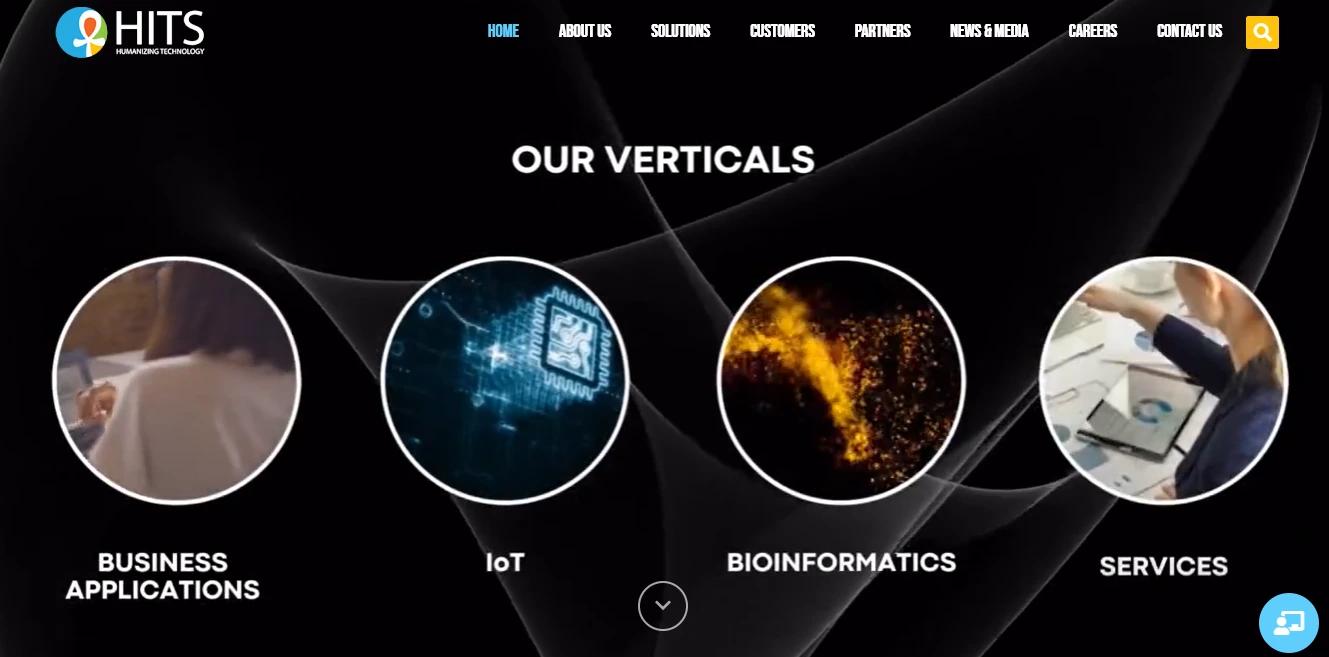
HITS is one of Egypt's longer-established HR software houses, developing human resources and people management systems for the local market.
HITS covers the core set - payroll processing, leave management, employee records, recruitment, with reporting and analytics on top, positioned around compliance with Egyptian labour regulations.
Pricing: No published rate card.
Rating: No third-party review profile.
Pros
- Long-established Egyptian presence with local support
- Built around Egyptian labour law compliance
- Serves both SME and larger enterprise deployments
- Arabic and English interface for a local workforce
Cons
- Publicly available product detail is thinner than for any other platform here
- Egypt-only, with no regional coverage
- Limited public information on integrations and product roadmap
- No published pricing or independent reviews, so reference calls matter more than usual
Best for: Egyptian organisations prioritising local support and an established local track record.
7. Mercans
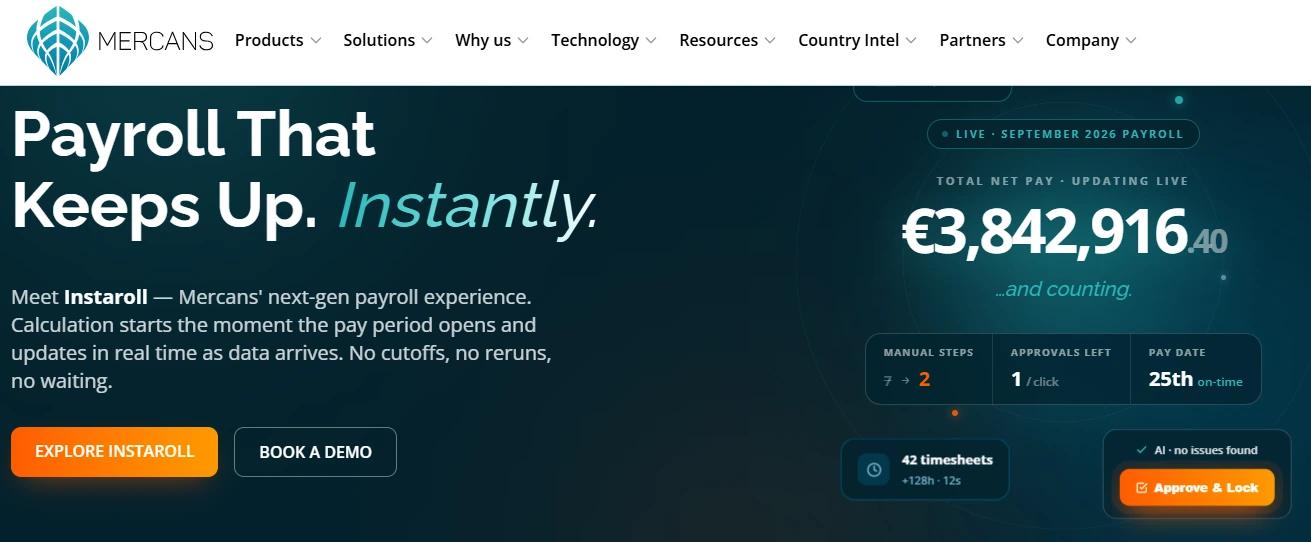
Mercans is a global payroll specialist with an Egypt-specific product aligned to the Ministry of Manpower, the Egyptian Tax Authority and the National Organization for Social Insurance.
Mercans is built for complexity rather than simplicity. Its payroll software handles processing, employee records, deductions and reporting within the Egyptian framework, designed to slot into a broader multi-country payroll architecture. The company operates across more than 160 countries with over 500 HR and payroll specialists, has been recognised as a leader in payroll business process transformation by Avasant and in payroll services by ISG, and holds approved Binding Corporate Rules for data privacy.
Pricing: No published rate card. Enterprise pricing with implementation costs.
Rating: 4.8 on G2.
Pros
- Explicit alignment to Egypt's three regulatory bodies: Ministry of Manpower, ETA and NOSI
- Coverage in 160+ countries makes Egypt one node in a unified global payroll
- Approved Binding Corporate Rules, a meaningful data privacy credential
- Large specialist team rather than software alone
Cons
- Substantial overkill for a business of 40 people in Cairo
- Enterprise pricing and implementation timelines
- Service-led model rather than self-serve software
- No published pricing, so evaluation starts with a sales process
Best for: 200+ employees, multinationals, and organisations where Egypt is one of many payroll jurisdictions.
8. Odoo HR
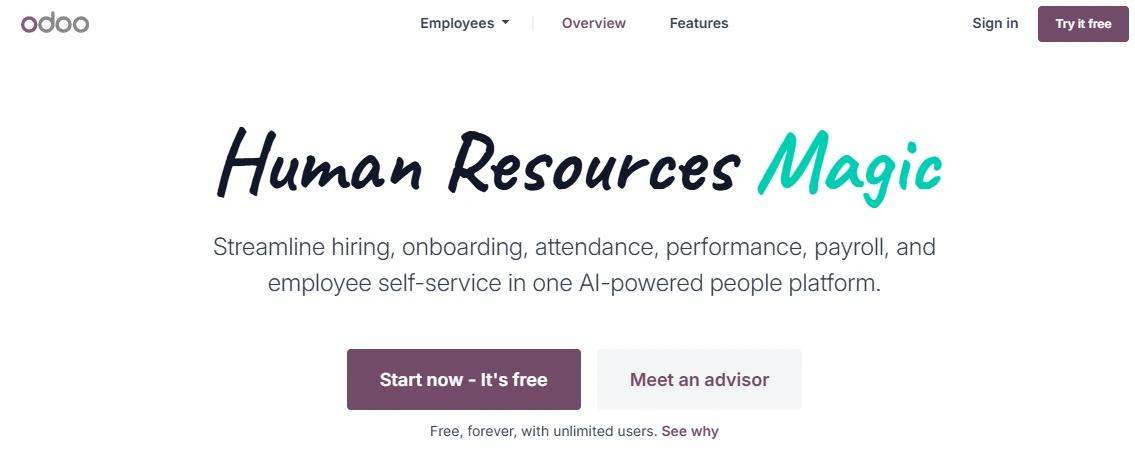
Odoo's HR modules are worth considering in one specific circumstance: you already run Odoo as your ERP.
The open-source model makes it inexpensive to license and highly modular - recruitment, attendance, leave, appraisals and payroll can each be added independently.
Pricing: Published publicly with a free entry tier. The genuine cost sits in localisation and implementation rather than licensing.
Rating: 4.3 on G2 for Odoo ERP.
Pros
- Lowest licensing cost here, with a free entry tier
- Highly modular - add only the HR functions you need
- Mature ecosystem with a large implementation partner network
- Deep integration if Odoo already runs your finance and operations
Cons
- Egyptian statutory payroll is not comprehensively covered out of the box
- Localisation depends on community modules or a paid local partner, so budget for that work
- Arabic support quality varies by module and community contribution
- No integration advantage at all if you're not already an Odoo shop
Best for: Existing Odoo ERP users with in-house or partner technical capacity.
Also Worth Shortlisting
Two Egyptian providers come up consistently in local market conversations: Fawry HR, part of the Fawry financial services group, and Mawared HR. Both were named by Bluworks as its principal competitors in the Egyptian SME segment. Public product detail is limited for both, so treat them as demo candidates rather than paper-evaluation candidates.
Some businesses also weigh outsourced HR services in Egypt against buying software. Outsourcing suits companies under 25 employees or those without an HR function; software becomes more economical as headcount grows and processes standardise.
Choosing The Best HR Software in Egypt By Company Size
Under 25 employees. Spreadsheets are defensible at this scale, but they break the moment you take on shift workers or face your first statutory audit. Bluworks if your team is frontline; ZenHR if it's office-based.
25–200 employees. This is where an HRMS stops being optional. You need attendance integration, configurable salary structures and multi-department reporting. Zimyo, ZenHR and Bluworks are the practical shortlist, with Menaitech worth adding if Arabic-first is non-negotiable.
200+ employees or multi-country. Integration depth with existing finance and HCM systems becomes the deciding factor. Menaitech and Mercans are built for it; Zimyo is a strong fit if your footprint spans Egypt and the GCC.
Five Questions to Ask Every Vendor
- How fast do you ship regulatory updates? The January insurable-wage adjustment is the test. Ask what date their 2026 figures went live.
- Is tax calculated annually or monthly? Monthly computation produces wrong results for lower-paid employees. There is one correct answer.
- Show me a payslip in Arabic. Not the interface — the generated document, with RTL layout.
- How do you handle the 3% statutory increment? It's calculated on insured salary, not gross. Systems built outside Egypt frequently get this wrong.
- What does this cost per month in EGP for my headcount? Ask before the demo, not after, and ask in pounds.
Making The Decision
The Egyptian market has a real advantage over many others: several credible options were built for it specifically rather than adapted from software designed elsewhere. So the question isn't which platform is best, it's which platform was built for a workforce like yours.
Start by identifying your constraint. If it's compliance risk, weight statutory automation heaviest. If it's frontline workforce chaos, weight scheduling and disbursement. If it's multi-country consolidation, weight breadth of coverage. Then run demos against the five questions above, and ask each vendor to walk through a real payroll run using 2026 figures.
Frequently Asked Questions
How much does HR software cost in Egypt?
Zimyo publishes Egypt pricing at EGP 150, 200 and 300 per user per month, minimum 25 users. Bluworks has indicated roughly EGP 51–82 per employee. Everyone else quotes on request, ask in EGP.
What is the best HR software for small businesses in Egypt?
Zimyo, for teams of 25 and above, the only platform here with published EGP pricing, covering HR, payroll, attendance and performance on one system. Under 25 employees, look at Bluworks for frontline teams or ZenHR for office-based ones.
Is there free HR software in Egypt?
Not practically. Odoo has a free tier but doesn't cover Egyptian statutory payroll out of the box. Free trials are the realistic route.
Can HR software calculate Egyptian social insurance and income tax automatically?
Some can, many can't. Egyptian payroll needs three deductions handled, social insurance, income tax and the Martyrs Fund, and platforms built outside the region often manage only one or two. Ask for a live payroll run using 2026 figures.
Which HR software do companies in Egypt use?
Zimyo, ZenHR, Bluworks, Menaitech, LoginHR, HITS and Mercans. Most international platforms in global roundups have no Egypt presence, check for NOSI, ETA and Arabic RTL support before assuming coverage.